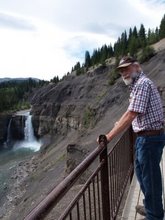
The Hand Hills region in Alberta, Canada, located southeast of Drumheller, is a geologically distinct area characterized by its unique formations, topographic features, and stratigraphic history. This overview details the geology of the Hand Hills based on the provided search results, focusing on bedrock formations, surficial deposits, and the area's geological evolution.

Bedrock Formations
The bedrock of the Hand Hills area comprises several formations spanning the Late Cretaceous to Tertiary periods. At the lower slopes, the bedrock belongs to the Tertiary and Cretaceous Paskapoo Formation, which consists primarily of grey and buff siltstone and mudstone, with thin coal beds and laminae interspersed throughout 14. The Paskapoo Formation is locally developed as thick sandstone beds with better permeability in the elevated regions of the Hand Hills 4. Underlying the Paskapoo, the Edmonton Formation, composed of alternating lenticular beds of argillaceous sandstone, shale, and coal, forms a significant part of the groundwater flow framework in the region, though its permeability is generally low due to high clay content 4. Beneath this lies the Bearpaw Formation, a relatively impermeable marine shale that acts as a barrier to the downward movement of meteoric water across the area 4.
The top of the Hand Hills is capped by the Hand Hills Formation, a lithostratigraphic unit of Miocene to Pliocene age (23.03–1.806 Ma), characterized by coarse gravel, often cemented into conglomerate, and sand, with components including quartzites, hard sandstones, minor cherts, and arkoses 25. This gravel capping, exceeding 15 feet in thickness in some areas, has played a crucial role in protecting the Hand Hills from glacial erosion, contributing to their preservation as an erosional remnant covering approximately 30 km by 15 km 16. Stratigraphically below the gravels, marl and light-colored clays are also included within the Hand Hills Formation, with marl deposits over 25 feet thick in certain locations 1.
Surficial Deposits and Topography
The surficial geology of the Hand Hills includes a variety of glacial and glaciofluvial deposits. The top of the Hills is covered by a thin veneer of ground moraine, while the surrounding landscape features buried gravels from the preglacial Hanna channel and lake and outwash sands south of Watts and Hanna, which have above-average permeability and hydrologic significance 14. The Hand Hills themselves rise over 500 feet above the surrounding plains, reaching a maximum elevation of over 3,500 feet within the study area, with bedrock at or near the surface along the entire flanks 1. The area surrounding Little Fish Lake, within the Hand Hills region, is capped by a remnant of a Tertiary plateau, sitting 146 meters higher than the adjacent landscape due to resistance to glacial erosion 3.
The region also exhibits a gently undulating topography with incised valleys and steep-sided coulees, reflecting both glacial and post-glacial processes 3. Late Pleistocene glacial geomorphology, including features like hanging tunnel channels, eskers, megadrumlins, and hummocky terrain, suggests significant glacial activity, potentially during the waning stages of floods that overtopped and sculpted the Hand Hills 89.
Geological Significance and Context
The Hand Hills are part of the broader Empress Group in Alberta, where formal formation status has been assigned to well-mapped upland units like the Hand Hills Formation 5. The area's geological history includes protection from erosion due to the resistant gravel cap, as well as interactions with glacial processes that shaped the surrounding badlands, composed of Cretaceous sandstones, siltstones, and shale 3. Additionally, the Hand Hills region exposes sequences from the Late Maastrichtian to Middle Paleocene, providing valuable insights into the stratigraphic and paleoenvironmental evolution of south-central Alberta 6.
Conclusion
The geology of the Hand Hills in Alberta is defined by a complex interplay of Cretaceous and Tertiary bedrock formations, including the Paskapoo, Edmonton, Bearpaw, and Hand Hills Formations, overlain by glacial and glaciofluvial deposits. The resistant gravel cap of the Hand Hills Formation has preserved the area from extensive glacial erosion, maintaining its elevated topography and distinct erosional remnant status. The region's varied lithology, from impermeable shales to permeable sandstones and gravels, alongside its glacial features, underscores its significance in understanding Alberta's geological history and hydrological dynamics.
- https://ags.aer.ca/publications/all-publications/ofr-1974-36
- https://weblex.canada.ca/html/006000/GSCC00053006196.html
- https://albertawilderness.ca/issues/wildlands/grasslands/hand-hills/
- https://ags.aer.ca/publications/all-publications/esr-1969-01
- https://cdnsciencepub.com/doi/10.1139/cjes-2022-0143
- https://pubs.geoscienceworld.org/cspg/bcpg/article-abstract/43/1/35/57635/Magnetobiostratigraphy-of-Late-Maastrichtian-to
- https://www.aptiantechnical.com/sites/default/files/useful-downloads/AGAT_Alberta_Table_of_Formations.pdf
- https://www.sciencedirect.com/science/article/abs/pii/0277379195000747
- https://gsa.confex.com/gsa/inqu/webprogram/Paper55684.html


No comments:
Post a Comment