Raw Opium
The opium poppy is botanically classified as Papaver somniferum. The genus is named from the Greek noun for a poppy, the species from the Latin word meaning 'sleep inducing': it was Linnaeus, the father of botany, who first classified it in his book Genera Plantarum in 1753. Like many of his contemporaries, and generations before him, he was well aware of its capabilities.
The plant has a dubious history. Some horticulturists consider it evolved naturally, but there are others who claim it is a cultivor developed by century upon century of careful human cultivation. Another theory is that it is a naturally mutated plant which evolved because of a quirk of climate or altitude. This is not far-fetched for plants will take on atypical forms in unique conditions: the cannabis trees of Bhutan prove the point. No one can be certain.
Although there is no positive proof, it is thought P. somniferum may have evolved, or been generated, either from the wild poppy, Papaver setigerum, which contains small amounts of opium and which indigenously grows throughout the countries bordering the Mediterranean Sea, or from a poppy native to Asia Minor.
To many not specifically engaged in its cultivation, the poppy is either an ornamental flower with a delicate beauty or a simple, scarlet blossom growing wild in the cereal fields of Europe, an image for the blood spilled in the trenches of the First World War. In fact, it comes from a large botanical family of 28 genera and over 250 individual species, most of which grow in the temperate and sub-tropical regions of the Northern Hemisphere. Many popular varieties have been specifically cultivated: the bush and tree poppies, the Welsh poppy, the blue and Syrian tulip poppies, the alpine poppy, the sub-arctic Iceland poppy, the Californian poppy. Even the opium poppy itself may be found in borders and displays in well-kept gardens, albeit illegally in most countries. In its wild state, the poppy is a single bloom but double flowers and specialist blooms with serrated and fringed petals have also been bred in a multitude of colours: the most exquisite are two variations of the opium poppy, the Pink Chiffon and the Paeony-flowered Mixed. Several species, such as the Oriental poppy from Asia Minor, are perennials.
Of all these species, only P. somniferum and P. bracteatum produce opium in any significant amount, although the latter is not used at present as a commercial drug source but is sometimes grown as decorative blossom from which a number of hybrids have derived.
Papaver somniferum is an annual with a growth cycle of approximately 120 days. It requires a rich, well-cultivated soil and, in the wild, is more likely to flourish in recently dug or ploughed ground, hence its presence in farm fields and, traditionally, by cart tracks and animal droves. The best growing climate is temperate, warm with low humidity and not too much rainfall during early growth. Ideally, although it will grow in clay or sandy clay, the best soil is a sandy loam which retains nutrients and moisture and is not too hard for the delicate early roots to penetrate. Both excessive and insufficient rainfall affect growth: too much moisture causes waterlogging and, if the soil is not properly drained, the plants will quickly die whilst dull, cloudy weather or excessive rain in days thirty to ninety of the growth period will reduce the opium-producing capabilities. Sunlight is especially important. The opium poppy is a 'long day' photo-responsive plant which means it will not produce blooms unless it has grown through a period of long days and short nights, preferably with direct sunlight at least twelve hours daily.
These requirements aside, the plant is easy to grow. It does not require irrigation unless it is in danger of drying out, demands no expensive fertilisers, has few pests or ailments and, therefore, requires no insecticides or fungicides.
The seeds (about the size of a pin-head) are naturally sown by the pod blowing in the breeze and shaking like a pepper-pot, the contents scattering. When deliberately set, they are either broadcast or dropped in rows of shallow holes made by a stick or dibber, the timing of the sowing depending heavily upon local seasonal and climatic conditions. About 500 grams of seed are sown to half a hectare. The seeds may range over a wide variety of colours from white through yellow to brown, grey or black, the coloration not being relevant to the eventual blossom. Other cash crops, such as beans, peas or tobacco, may be planted alongside the poppy: these do not hinder it and are usually only a means of obtaining a higher return from the same area of land.
The seeds germinate quickly in warm, moist conditions and, within six weeks, the plant is established by which time it vaguely resembles a young cabbage with glaucous, green leaves with a dull grey or bluish tint. By eight weeks, it reaches a height of about 60 centimetres and consists of a main stem the upper portion of which (the peduncle) bears no leaves or secondary stems. Below the peduncle, secondary stems (called tillers) may appear from leaf bases where they join the main stem. Apart from the peduncle, the stems are frequently covered with hairs.
As the plant matures, it grows to a height of between 90 and 150 centimetres, the leaves appearing alternately, those on the main stem being oblong, tooth-edged and between 10 and 40 centimetres long. The main stem and each tiller ends in a single flower bud. As these develop, the ends of the peduncle and tillers extend and bend over to form a distinctive hook shape, the young buds suspended upside down. However, as the buds mature the stems straighten, the main bud at the head of the peduncle pointing upwards. Within two days of becoming vertical, the sepals of the bud - which are the same colour as the leaves - open and the flower blooms. In ideal conditions, the main blossom appears around the ninetieth day from germination.
At first, it appears crumpled, like a butterfly emerging from its chrysalis, but the four petals quickly expand and smoothen, each marginally overlapping the other. Their colour may vary from plant to plant. Traditionally, opium poppies are white but they may just as readily be pink crimson, weakly purple or a variegation of these with the colour darker at the petal base. Inside the flower is a ring of anthers on top of what will become the pod. Fertilisation is carried out by insects.
The flower is short-lived. In two to four days the petals drop, exposing a small, round pod the size of a large pea. This rapidly grows and may become ovoid or globular: when mature, it is the size of a small hen's egg with a diameter of between 5 and 7.5 centimetres. It is bluish green with a slightly waxy appearance, the top surrounded by a small crown from which the stigmas rise. Where the pod joins the peduncle is a ring of petal base scars.
The pod is made of an outer skin enclosing the wall of the ovary, which is made up of three layers, and cavities or segments separated by seed-producing walls. The seeds, of which one pod may produce over 1000, are reniform in shape with distinct reticulations. When mature, they are loose in the pod before dispersal through small holes which open just under the crown.
The opium poppy has two main products: one, the seeds, is quite innocuous whilst the other, opium, is infamously insidious.
The word 'opium' is misleading, implying the substance is a single chemical compound whereas it is an elaborate cocktail containing sugars, proteins, ammonia, latex, gums, plant wax, fats, sulphuric and lactic acids, water, meconic acid and a wide range of alkaloids. The significant parts are the alkaloids.
An alkaloid is a highly complex organic base (an alkali) with the common characteristic properties of containing nitrogen, of being basic and forming salts and water with acids, found in plants and having a characteristically bitter taste. Over fifty have been identified in opium, the most important being morphine (from which heroin can be made noscapine, papaverine, codeine and thebaine. They appear partially or loosely chemically bonded to meconic acid, the presence of which can be used as a test to detect opium.
In its raw state, opium is the dried latex or juice of the seed pod which is also known as the capsule, bulb or poppy-head. It is an opaque, milky sap which, although found throughout the plant, concentrates the active ingredients in the pod.
Until recently, it was unknown how the poppy manufactured such a complex chemical as an alkaloid. It is now accepted that the substances are actually created in the lactifers (cells which produce the latex), possibly from the synthesis of albumen: the mechanism, however, is still undiscovered. Furthermore, opium is only produced during a ten-to-twelve-day period when the pod is ripening. Once it has reached maturity, the alkaloids are no longer made and are broken down in time.
Why the plant goes through such a process is unknown. Theories abound. One suggests the alkaloids are essential to the formation of the seeds. Another proposes they are a form of deterrent against animal pests. The most intriguing propounds that the plant has developed opium simply to ensure humans maintain it in cultivation, an elaborate and incredibly ingenious example of symbiosis.
Harvesting opium is an exhausting, back-breaking and labour-intensive process which can really only be done by hand and requires knowledge, experience and dexterity. Little changed for centuries, it is obtained by tapping the individual pods.
The harvest begins about two weeks after the petals have dropped. The opium farmer first examines the pod and erect crown. By now, the pod will have lost its grey-green colour and darkened. If the points of the crown are standing straight out or curving upwards, the pod is ready. Not all the pods in a field will mature at the same time so the farmer has to keep a close daily eye on his whole crop over a period of some weeks.
Today, the tapping tool is generally a specialised knife consisting of a set of three or four parallel steel or glass blades mounted on a handle. This is run vertically over two or three sides of the pod. If the blades cut too deeply into the pod wall, the opium will flow too quickly and drip to the earth where it will be lost. Furthermore, deep incisions will cause it to weep internally and injure the pod, cutting off production will the lactifers and preventing the seeds from developing. The will then shrivel and die. If the cuts are too shallow, the flow be too slow and harden on the pod wall, sealing the cut like a scab. The ideal depth for a cut is 1-1.5 millimetres, achieved by setting the tapping knife blades.
The tapping (also known as scoring or lancing) is sometimes carried out in the late afternoon in the hope that the opium will ooze out overnight and coagulate slowly on the surface of the pod. If the tapping is carried out when the sun is still high, the heat of the sunlight can dry up the first sap to appear which then closes the wounds: however, in some countries, the collection of sap is done at midday, the sun's heat actually encouraging the milky sap to trickle out.
When the opium first appears, it is a cloudy, white, fairly mobile substance but on contact with air it oxidises, turning into a dark brown, viscous substance, sticky to the touch with a distinctive delicate perfume. The opium, now a resinous gum, is carefully scraped from the pod with a short-handled blunt iron blade about 10 centimetres, long. In order to prevent the blade from becoming covered in gum, the farmer wets it between plants. Poppy growers working on licensed farms, where poppies are cultivated for the pharmaceutical industry, do this by dipping the blade in water, peasant farmers, who are the vast majority of the world's poppy growers, often simply lick the blade. Needless to say, this addicts the farmers to their crop.
A pod will continue to secrete opium for some days and may be tapped up to half a dozen times. The opium yield varies according to the size of the pod and the efficiency of the farmer. The average is 50 milligrams per pod, a hectare of poppies providing, between 8 and 15 kilograms of raw opium.
The farmers work their way backwards across the fields, tapping lower mature pods before the taller ones so as not to spill the opium inadvertently. This is collected in a container hanging around the farmer's waist. As they go, they mark the larger or more potent pods with coloured yarn. This directs the farmer to the pods on subsequent harvesting sessions and indicates which are eventually to be gathered in whole. These will be opened, dried in the sun and the seeds collected for the next season's planting.
In gum form, raw opium contains a high percentage of water so it is sun-dried for several days until the mass is reduced by evaporation to a sticky, dark brown substance with a strong odour and the consistency of warmed beeswax. The freshness of raw opium is judged by its pliability: when fresh, it is putty-like. It is then beaten into an homogeneous mass and moulded into cakes, balls or blocks which can be stored for months, wrapped in plastic or leaves and stacked on shelves in a shady place. As it dries, it hardens. Excessive moisture or heat during drying or early storage will cause it to deteriorate but, once dried, it is stable and will gain in value for the older it is the less water it contains and the more concentrated it becomes by weight. In some cases, harvested pods are gathered and pulped in warm water which is then sieved and simmered over a fire, resulting in a poor quality opium which is not traded but may be retained by the farmer for personal use.
Raw opium, which is slightly granular, contains more than just the coagulated latex. In the scraping of the pod, pieces of the outer wall may be removed and up to 7 per cent by weight of raw opium may consist of extraneous plant matter. What is more, it can be deliberately adulterated by the farmer with sand, tree sap or ash, although a trained opium buyer can spot these tricks and few farmers dare resort to such chicanery.
Before the opium can be smoked or further processed, it has to be cooked. As traders usually prefer it somewhat improved from its rough state, cooking also prepares it for market.
The cooking is done by adding the raw opium to boiling water. It dissolves, any impurities such as pod fragments floating to the surface with heavier adulterates sinking to the bottom. The solution is passed through cheesecloth or a fine sieve to remove impurities then brought to the boil again and reduced. It is now a clean, brown, mobile fluid known as liquid opium. Very slowly, it is left to simmer until all that remains is a thick, brown paste known as prepared, cooked or smoking opium. This is pressed into moulds or trays and dried once more in the sun until it takes on the consistency of dense modelling clay which will harden as it matures. Much purer than raw opium, the cooked opium is now ready for the addict, the trader or the drug baron's laboratories.
The remainder of the plant is not discarded. Once ripe, the seeds contain no dangerous substances whatsoever and are edible. Black, blue and grey seeds are frequently used as a decoration for cakes and bread whilst brown seeds are used in Turkey to make halva and to give the typical crunchiness to such traditional Turkish pastries as silgin boereghi and hashash coereghi. In India, yellow seeds are milled and added to sauces as flavouring or thickening agents.
Ripe poppy seeds yield about 50 per of a fixed oil made up of the glycerides of linolic, oleic, palmitic and stearic acids. Poppy seed oil has a straw-yellow colour, is odourless and tastes vaguely of almonds. It may be employed in cooking and as a salad dressing and it has been used as an adulterate of olive oil. Other uses are in the manufacture of perfumes and, because of its drying properties, as a base for expensive artists' oil paints.
In the nineteenth century, Turkish growers wasted little of the plant. Seeds were pressed to give both vegetable and lamp oil, the residual seed cake, stems and leaves being used as cattle fodder. This was historically an important factor in dairy produce, for cows fed on the detritus of poppies were said to provide the milk which made the finest yoghurt. Mixed with flour, the residuals also made a coarse bread. Seed was also sold to merchants in Smyrna who traded it on to Marseilles, where it was used in soap factories, whilst poppy heads were infused to make a traditional sedative drink.
Today, in most areas where the plant is commercially and legally grown, the opium producing stage is bypassed and the dried capsules, known as poppy straw, are milled and processed for the extraction of their alkaloids. Very large quantities of poppy straw have to be processed, but morphine, codeine and thebaine are recoverable. The seeds, which have almost as much value, are used in the food industry.
Although poppy straw morphine was extracted first in 1823 by a French chemist called Tilloy working in Dijon, it was not until 1928 that a factory was built when Janos Kabay, an Hungarian, developed a commercially feasible extraction process. During the Second World War, poppy straw processing began under German control as a source of opium during the Allied blockade. Since then, refinements to extraction techniques, and agricultural development have greatly increased yields, so that today more than 50 per cent of the world's legal annual morphine demand of about 230 tonnes is derived from this source which, in some countries such as Australia, is a highly mechanised agricultural procedure.
The traditional growing, harvesting and preparation of opium however is and always has been essentially a peasant-farming activity, although there have been variations according to time and place. In Bengal, for example, it was customary to incise the pod with a sharpened mussel shell whilst elsewhere the extruded juice was placed upon a lower leaf of the plant to dry, a practice which lingers in parts of Afghanistan. However, from the late eighteenth century and with the expansion in world trade promoted by Europeans, opium growing and production became in places a highly organised, efficient and lucrative industry.
In India in the nineteenth century, opium growing was far from being a peasant-run operation. Admittedly, smallholders produced the opium but it was sold through a structured market and was big business, employing tens of thousands of growers and workers, many of whom became habituated to the drug.
As a commercial commodity, opium was an extensive branch of Indian agriculture. Grown mostly on the Ganges plain between Patna and Benares (now known as Varanasi), it was a major revenue source for the Indian economy. Its importance is reflected in the substantial records compiled about the business which afford a fascinating glimpse of how the industry began in modern times.
Sown early in November, the crop was harvested from early February the following year. The tapping tool (known as a nushtur) was of similar design to that used today, whilst the collecting blade was an iron scoop (a sittooha) and the collecting vessel an earthenware pot called a kurrace. This was emptied into a shallow tilted brass dish (a thallee) which allowed the water content (pusseewah) to drain away. The raw opium was allowed to dry for several weeks, being turned and stirred daily, before being stored in clay pots in godowns, or warehouses. Once weighed, tested and valued, it was thrown into vast vats, kneaded and subsequently pressed into spheres the size of small cannon balls.
This process was an important part of opium manufacture. The factory hands sat in rows in the godown, each man in front of a tagar, a tin vessel holding enough opium to make three to five balls. A basin containing water, a supply of poppy flower petals, a cup of lewah (inferior opium) and a brass cup in which the ball was shaped made up the rest of a worker's equipment.
Taking the cup, the worker placed a petal in the base and smeared it with lewah. Another petal was added overlapping the first until the receptacle was lined by opium-soaked petals. An opium ball was rolled and placed in the cup so the dome protruding from the top was the same size as that contained by the vessel. This was then covered in poppy petals and lewah, the petals at the rim carefully interwoven to make a seal. When completed, the ball was about 15 centimetres in diameter and covered in a shell of petals. It weighed about 1.5 kilograms.
Once the ball was formed, it was placed on lattice-work racks in a drying room, a warehouse with open ends to allow the wind to pass through. Checked and turned daily by small boys, who ensured no insects were damaging the opium, it was kept until sufficiently dry then packed into mango-wood chests with two fitted trays, each chest containing forty balls in individual compartments, twenty to a tray. The chests were sealed with pitch, sewn into gunny or hides and sent for trading or to market. In Ghazipur, the centre of India's modern legal opium production system, some opium-making equipment a century old is still in use in technique which have not significantly changed for 200 years.
The size of the opium industry can be judged from contemporary accounts. The area under poppy cultivation in 1870 was 560,608 acres. In the financial year of 1871-72, the number of chests sold was 49,695 at a trade price of 139 [pounds sterling] each. The net profit per chest was 90 [pounds sterling]. The opium revenue came to 7,657,213 [pounds sterling]. At 1996 currency rates, equates to approximately 612 [pounds sterling] million or $950 million.
The product and the style of marketing varied from place to place. While Indian opium was sold in forty-ball chests in the nineteenth century, Turkish opium from Smyrna - upon which was based a speculative commodities market - was packed in grey calico bags in oblong wicker baskets, the strength and quality of the goods being measured in carats on a 1 to 24 unit scale like gold: under 20 carats, the standard was considered poor and the opium discarded. The opium was blackish-brown, waxy to the touch, wrapped in poppy leaves and sold in irregular, flattened oval cakes weighing between 250 gram and a kilogram. The surface of each was sprinkled with the winged seeds of a species of sorrel to prevent them from sticking together. When shipped, it was transported in hermetically sealed, zinc-lined wooden cases, each sufficiently large to take an entire basket.
An alternative Turkish opium from Constantinople was a redder brown and sold in small lens-shaped cakes covered with poppy leaves whilst Persian opium from Yezd and Isfahan, where the Persian trade was centred, was usually dark brown and came in the form of sticks wrapped in grease-proof paper and tied about with cotton twine, or cones weighing 200-400 grams. Egyptian opium was formed into round, flattened cakes like ice hockey pucks, was reddish in colour and quite hard.
Aficionados, dealers, merchants and users were expert at assessing quality and strength in each and every variety and cargo. Opium was judged with all the finesse of a tea or coffee blender, the pertinent factors being its colour, weight, density, water content and granularity. Many traders could identify and judge the quality of individual samples just as experienced wine tasters can tell the vintage of a bottle of claret and from which vineyard it comes.
When and how man first discovered the potency of opium is hard to ascertain: he has been familiar with it since prehistoric times. The nineteenth century botanist, George Watts, suggested man came upon the poppy's secret by stages of gradual awareness. Watts conjectured that humans aesthetically appreciated the poppy for its flower before they came to use it as a vegetable: certainly, it was eaten in salads in India as recently as the 1890s, although this may have been for its medicinal qualities. The juice was then found to make a refreshing drink when diluted with water and, eventually, the neat juice would be discovered to have narcotic effects inducing feelings of contentment and capable of numbing pain.
However that first discovery might have been made, today it is known that opiates can be swallowed, smoked, injected, sniffed, inhaled or absorbed through mucous membranes. How it is taken affects the intensity and speed with which it has an effect upon the brain and the whole body.
Historically, there have been only two basic ways to indulge in opium: one was to eat it, the other to smoke it.
Opium eating refers, in effect, to the general swallowing of it for as well as eating it in solid form it is also possible to drink raw opium dissolved in a variety of liquids. Opium in solution might well have been the first common method of taking it as, before the technique of cutting the pods to allow the sap to ooze out, the whole poppy head was crushed and mixed with wine or honey and water. Such a solution served more than one purpose for raw opium has a bitter taste and eating it neat would not have been easy: indeed, raw opium can induce severe vomiting.
Despite this, it was taken orally in India for over 1500 years, the dictum going that efficacy improved with unpalatability. In 1687, it was recorded the Turks ate opium for pleasure but disguised the bitterness with nutmeg, cardamom, cinnamon or mace and served it with saffron or ambergris. Even then, it was essentially a medicine and regarded as an aphrodisiac. In Europe, opium was mixed with wine or wine and sugar or honey.
Smoking opium was chiefly confined to China, the East Indies, the eastern seaboard of Indo-China (particularly Vietnam) and Taiwan (formerly Formosa). It had to be concentrated before it could be used. A method of preparing opium for smoking was published in the British Pharmacopoeia in the early nineteenth century:
Take of opium in thin slices, 1lb; distilled water 6 pints. Macerate the opium in 2 pints of water for 24 hours, an express the liquor. Reduce the residue of the opium to a uniform pulp, macerate it again in 2 pints of water for 24 hours, and express. Repeat the operation a third time. Mix the liquors, strain through flannel, and evaporate by a water-bath until the extract has acquired a suitable consistence for forming pills.
Once the extract was produced, the opium mass had been reduced by about 50 per cent, the concentration more or less doubled. Known in China as chan du, the pills were round, pea-sized, dark-coloured and stiffly malleable.
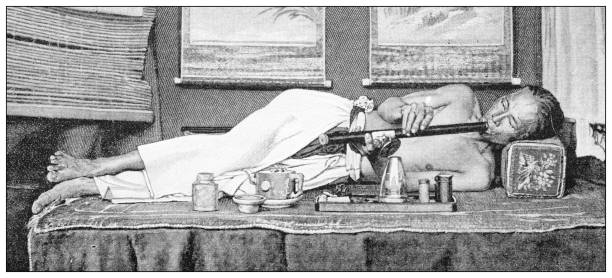
A traditional opium pipe was quite unlike that used by tobacco smokers. There were variations but basically it consisted of a broad tube (often made of a length of bamboo about 5 centimetres in diameter and perhaps 50 centimetres long) with a smaller, usually metal, tube protruding about two-thirds of the way down, ending in a tiny cup or bowl up to 2 centimetres across. In typical Chinese pipes, the bowl was a hollow chamber with a tiny hole in the roof.
The would-be smoker reclined on his side and held the pipe in one hand. With the other he took a thin metal spike or needle about 15 centimetres long, impaling the pill of opium on the end. This task of preparing the pill was traditionally carried out in opium dens by small boys who were, on occasion, also catamites. If the pill was too moist, it was dried over the flame of a small, specifically designed spirit lamp which produced a fierce hot spot above a toughened glass cowl. With the desired consistency achieved, the opium was spread around the base of the bowl or placed over the hole of the hollow bowl by inserting the spike into the hole and pulling it free, the index and second fingers of the pipe hand holding it in place. The bowl was then inverted over the spirit lamp until the opium pill melted and began to vaporise. At this moment, the smoker took a very deep breath and sucked air rich with opium fumes through the main tube. Some early Chinese pipes were similar to hookahs, the fumes drawn through water or scented liquid before inhalation.
The action was ideally done in one large inhalation for the opium was quick to vaporise: a pipe took between fifteen and thirty seconds to run its course. The pipe characteristically whistled while the opium was drawn in. As the smoker inhaled, he sometimes manipulated the opium with a needle-like probe to keep an air-hole open and to force the opium into the chamber of the bowl. Unvaporised opium, or vapour which had not been inhaled, solidified on the interior of the pipes: needless to say, old pipes had a value because they were coated with a residue of raw opium which could be recycled. Known as 'dross', it was a mixture of charcoal, empyreumatic oil and opium and was sold as pills to the poor or mixed with tobacco, tea or some other material smoked by them.
The inhaled fumes were retained as long as the smoker could hold his breath, exhalation made only through the nostrils to gain the best advantage of the fumes: what the lungs did not absorb, the nose might take in. A first-time user was usually nauseated by his pipe but this effect passed after two or three further pipes, diminishing with each. Experienced smokers would take three or four pipes in quick succession, a pipe consisting of one pill.
His smoking over, the smoker fell into a deep but not refreshing sleep which could last from fifteen minutes (with one pipe) to several hours. Upon waking, there were no after-effects, such as a hangover. The smoker was subdued and calm, in a state of extreme lassitude.
The habit of reclining to smoke opium had its origins in China but was not essential: it was, however, convenient for the smoker would quickly fall asleep after his pipe, the effects of which were quite rapid. As Jean Cocteau, the French writer and opium addict, observed: 'Of all drugs "the drug" is the most delicate. The lungs instantaneously assimilate its smoke. The effect of a pipe is immediate.' He called opium 'the ultimate siesta'.
The method of smoking opium has not changed and, in the few places were it is still smoked today, such as the Shan states of north-east Burma (now called the Union of Myanmar), China, Laos and Thailand, the technique and paraphernalia survive. Opium smoking is in fact legal in some countries, notably in the Middle East, where it is sold as sticks about the size of a hot dog sausage.
One does not have to be an addict, or an eater or smoker, to come under the effect of opium: passive consumption is possible. Walking through a field of incised pods can induce mild effects and poppy farmers can tell when the time to harvest is nigh because they wake in the morning with severe headaches and even nausea. Harvesters may absorb opium through their skin and excise officers and traders who come into frequent contact with it can also be affected.
Opium is still consumed by the traditional means of eating and smoking in Third World countries, especially in those where it is produced, but in more technologically advanced nations opium is not widely used today. Its derivative, heroin, is the main opiate of addiction and there are several ways in which that drug can be taken. Unlike opium, heroin is rarely swallowed because this is an ineffectual method of consumption but it is frequently smoked, either mixed with tobacco in a hand-rolled reefer or 'joint', or inserted into a cigarette filter tip.
Smoking is, however, a relatively inefficient way of taking heroin and requires a high purity to be effective. The best non-injectable way to use heroin is to sniff it in powder form through the nostrils - a method known as 'snorting' - which allows absorption into the bloodstream through the nasal mucous membranes.
The quickest, most effective way to take heroin is to inject it. This requires certain equipment: a cooker (usually a large spoon), a source of flame and a hypodermic syringe. The addict mixes heroin in the spoon with water, or glucose and water, in order to dissolve it. Lemon juice, citric acid or vitamin C may be added to aid dissolving. This cocktail is heated until it boils, drawn into the syringe through a piece of cotton wool or a cigarette filter to remove solid impurities and injected whilst still warm. An addict calls his equipment his 'works' or 'kit'.
Subcutaneous injection is known by addicts as 'skin-popping', whilst intravenous injection - injecting straight into the vein - is called 'mainlining.' The mainliner also requires a tourniquet of some sort to distend veins. When the tourniquet is released, the effects of the heroin are almost instantaneous. Most heroin is taken by injection: however, since the arrival of AIDS and the risk of cross-infection through shared needles, the habit of smoking and snorting heroin has been on the gradual increase.
Whatever the means of consumption, whatever methods of taking the drug have become tenable or fashionable, the fact remains that, well before man had developed into a civilised, social being, he had discovered the precarious magic of poppy sap.
(C) 1996 Martin Booth All rights reserved. ISBN: 0-312-18643-6