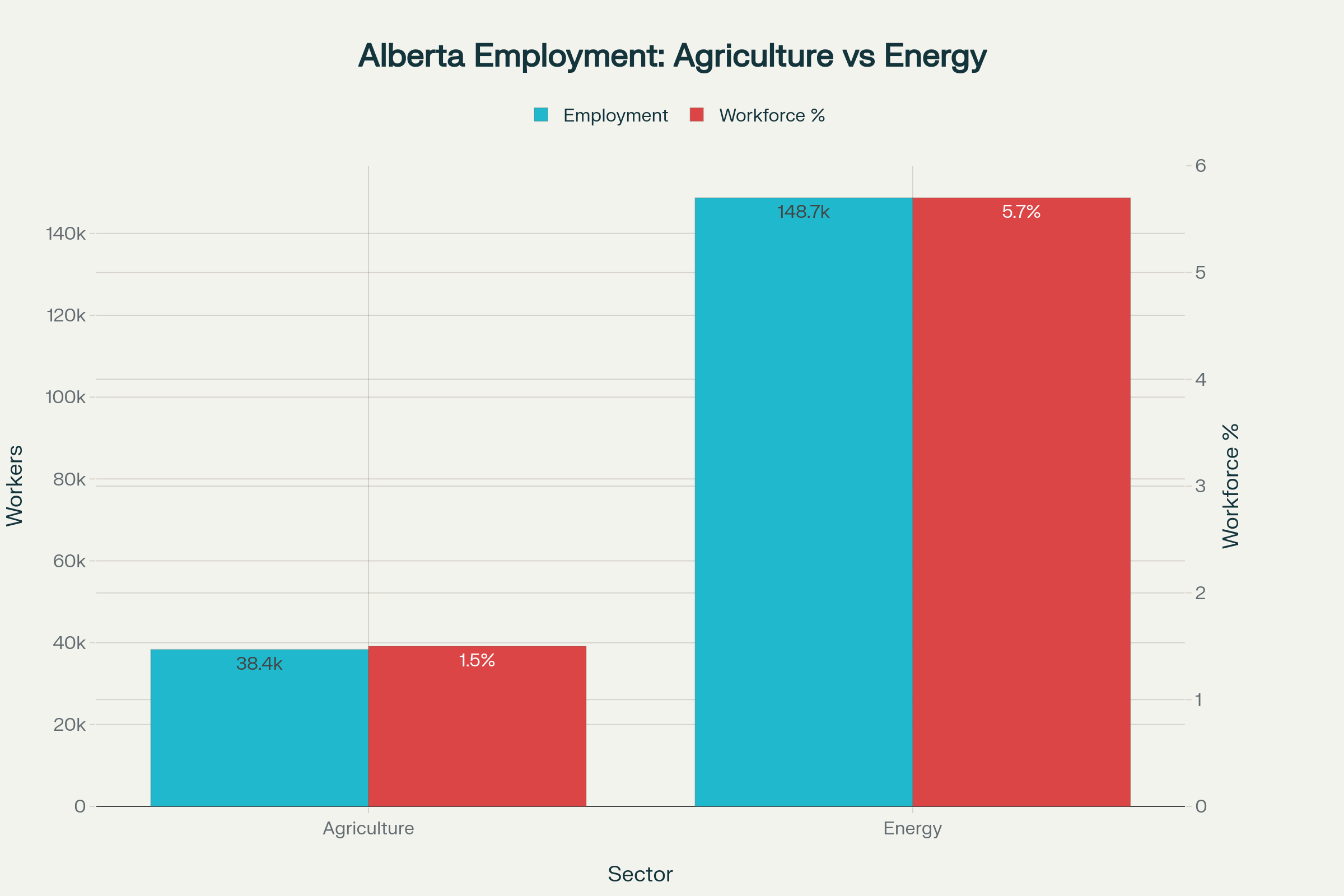
The energy sector significantly outpaces agriculture in employment, with oil and gas employing nearly four times as many Albertans as the agricultural sector in 2024.
Current Employment Numbers
Energy sector dominance is clear in workforce statistics. The oil and gas industry employed 148,700 workers in 2024, representing 5.7% of Alberta's total workforce. This marks the highest employment level in the energy sector since 2015 and represents a substantial 15,000-job increase from 2023.economicdashboard.alberta+1
In contrast, Alberta's agriculture sector employed 38,358 workers in 2024, accounting for just 1.5% of the provincial workforce. While smaller, the agricultural workforce showed modest growth of 6.8% since 2021, when employment stood at 35,900 workers.jobbank+1
Employment Ratio Analysis
The employment ratio between energy and agriculture stands at approximately 3.9:1[calculation based on employment figures], meaning the energy sector employs nearly four workers for every agricultural worker in the province. Combined, these two natural resource sectors account for 187,058 workers or 7.2% of Alberta's total workforce, with energy representing 79.5% of this combined natural resource employment.
Sectoral Employment Trends
Energy Sector Growth Pattern: The energy sector experienced significant volatility over the past decade. Employment peaked at 171,364 workers in December 2013 during the oil sands construction boom, before declining substantially. The sector has lost over 33,000 jobs permanently in the past decade due to automation and efficiency improvements, yet still managed strong recovery in recent years with 10.7% growth in 2024.diversifyalberta+1
Agriculture Sector Composition: Agricultural employment is distributed across several subsectors, with beef cattle operations employing 28% of agricultural workers, grain and oilseed production accounting for 14%, and greenhouse, nursery, and floriculture operations representing 9%. The remaining 49% work in other agricultural activities including mixed farming and support services.jobbank+1
Labor Market Challenges
Energy Sector Workforce Issues: Despite recent growth, the energy sector faces structural changes. Over 22% of the current energy workforce is nearing retirement, and 27% of companies report difficulty recruiting for advanced technical roles created by industry-wide automation. The sector increasingly demands workers skilled in automation, artificial intelligence, and environmental compliance.mokid
Agriculture Labor Shortages: The agricultural sector faces more acute workforce challenges. 50% of agricultural employers in Alberta cannot fill all available positions, leading to cancelled expansions and lost sales. The situation is expected to worsen as 40% of the current agricultural workforce is projected to retire by 2030.mokid+1
Geographic Distribution and Wage Differentials
Energy Employment Concentration: Energy sector jobs are heavily concentrated in urban centers, with 47.6% (9,900 workers) in the Calgary economic region and 25.5% (5,300 workers) in Edmonton. The sector offers higher wages, with utilities workers earning a median hourly wage of $51.28 compared to the provincial median of $30.77.jobbank
Agriculture Wage Competition: Agricultural employers face challenges competing with the energy sector for workers. The median hourly wage for agricultural workers was $22.00 in 2021, significantly below energy sector wages. This wage gap makes it harder for agricultural operations to attract and retain workers, particularly given that agricultural jobs are predominantly located in rural areas where many workers are unwilling to move or commute.jobbank+1
Future Employment Projections
Energy Transition Impact: The energy sector faces continued transformation, with projections suggesting as many as 50,000 more energy jobs may be cut due to automation by 2040. However, clean energy initiatives could offset some losses, with estimates of 65,000 clean economy jobs potentially added in Alberta by 2030 and the manufacturing sector alone expected to add 80,000 jobs by 2030.diversifyalberta+1
Agriculture Growth Potential: Despite workforce challenges, Alberta's agricultural sector shows positive production trends. Grain and oilseed production is predicted to grow by 2.5% annually until 2029, while greenhouse and floriculture operations are expected to grow by 2.3% annually. However, the widening labor gap threatens to reach 32% of total labor demand by 2029, meaning nearly one in three agricultural jobs risk going unfilled without intervention.cahrc-ccrha
The employment comparison reveals that while both sectors face workforce challenges, they differ significantly in scale, wage levels, and future prospects. Energy sector employment, though volatile, remains the dominant employer in Alberta's natural resource economy, while agriculture struggles with chronic labor shortages despite steady production growth.
- https://economicdashboard.alberta.ca/dashboard/employment/
- https://www.atb.com/company/insights/the-twenty-four/employment-growth-by-industry-in-alberta-in-2024/
- https://www.jobbank.gc.ca/trend-analysis/job-market-reports/alberta/sectoral-profile-agriculture
- https://mokid.ca/blogs/insights/alberta-employment-statistics/
- https://diversifyalberta.ca/alberta-government-leadership-on-energy-diversification-needed-to-create-jobs-lost-to-oil-and-gas-automation/
- https://careersinenergy.ca/wp-content/uploads/2025/02/Annual-2024-LF-Update_West_FINAL_Jan-30-2025.pdf
- https://cahrc-ccrha.ca/sites/default/files/2021-11/AB_EN_Reduced%20size.pdf
- https://mokid.ca/blogs/insights/alberta-oil-and-gas-employment-statistics/
- https://www.jobbank.gc.ca/trend-analysis/job-market-reports/alberta/sectoral-profile-utilities
- https://www.pembina.org/blog/alberta-can-invest-clean-economy-grow-jobs
- https://www.qc.jobbank.gc.ca/trend-analysis/job-market-reports/alberta/sectoral-profile-mining-oil-gas
- https://ca.indeed.com/q-alberta-energy-jobs.html
- https://www.aer.ca/about-aer/work-with-us/careers
- https://calgaryeconomicdevelopment.com/sectors/energy-environment/
- https://www.atb.com/company/insights/the-twenty-four/a-profile-of-natural-resource-jobs-in-alberta/
- https://careersinenergy.ca
- https://www150.statcan.gc.ca/n1/pub/96-325-x/2021001/article/00009-eng.htm
- https://www.biv.com/news/resources-agriculture/fossil-fuel-jobs-fail-to-keep-pace-with-production-and-profits-report-finds-11077060
- https://jobpostings.alberta.ca
- https://economicdashboard.alberta.ca/dashboard/employment-rate/
- https://careersinenergy.ca/employment-and-labour-data/
- https://theconversation.com/how-to-ensure-albertas-oil-and-gas-workers-have-jobs-during-the-energy-transition-215770
- https://www.atb.com/company/insights/the-twenty-four/employment-by-industry-in-alberta-to-august-2024/
- https://businesscouncilab.com/wp-content/uploads/2024/03/BCA_PDIM_Hiring_In_Alberta_Labour_Market_Information-DISTRIBUTION.pdf
- https://www.medicinehat.ca/en/Microsite_MH-Ec-Dev/Documents/2024_Labour-Market-Profile-_Southeast-Alberta.pdf
- https://economicdashboard.alberta.ca/dashboard/labour-force
- https://publications.gc.ca/collections/collection_2019/edsc-esdc/em2-2/Em2-2-2019-3-eng.pdf
- https://ehrc.ca/wp-content/uploads/2023/07/LMI-Alberta_Report.pdf
- https://open.alberta.ca/publications/2727158
- https://www.reddit.com/r/alberta/comments/1i2u8k2/how_much_of_albertas_industry_is_not_oil_and_gas/
- https://www150.statcan.gc.ca/t1/tbl1/en/tv.action?pid=1410035501
- https://www.ucalgary.ca/sustainability/mobilizing-alberta/climate-action-blogs/jobs-alberta-opportunities-clean-economy
- https://www.jobbank.gc.ca/trend-analysis/job-market-reports/alberta/environmental-scan
- https://energy-information.canada.ca/en/energy-facts/skills-diversity-community
- https://www.calgary.ca/content/dam/www/cfod/finance/documents/corporate-economics/labour-market-review/Labour-Market-Review-2024-08.pdf


No comments:
Post a Comment