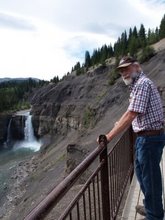
Opinion by Helge Nome
I know that many of you readers keep an eye on stock market indexes as they bounce around from day to day. The DOW Industrial, NASDAQ, etc. And stock market indexes overseas in Asia, and down under in Oz. What do these indexes tell us about the economy? Not a lot. They say something about what is happening in the speculative economy where people try to multiply their money as quickly as possible, with little regard for consequences in the real economy, but that’s about it.
So, are there any reliable indicators of what is going on in the real economy where goods and services are produced and exchanged, as opposed to simply zipping computer generated numbers across the oceans? Indeed there are, and I have come across three of them so far: The Baltic Dry Index or “BALDRY” (nothing to do with champagne), the copper index and the “HARPEX” (Harper Petersen Index). These are all leading economic indicators, as opposed to trailing ones like unemployment numbers, for example.
The Baltic Dry Index(BDI) is a number issued daily by the London-based Baltic Exchange. Not restricted to Baltic Sea countries, the index tracks worldwide international shipping prices of various dry bulk cargoes. The index provides an assessment of the price of moving the major raw materials by sea. Taking in 26 shipping routes measured on a timecharter and voyage basis, the index covers Handymax, Panamax, and Capesize dry bulk carriers carrying a range of commodities including coal, iron ore and grain. This index is way down right now, indicating a slowdown in the real (productive) economy.
Copper prices are also way down and copper is used in an awful lot of manufactured goods, so it is a good indicator of economic activity.
In contrast to the BDI which typically measures bulk cargoes – ore, crude oil, coal and grain, the HARPEX typically measures finished goods – the containers of electronics from Taiwan, toys from China, textiles from Italy and so on. Accordingly it is a good indicator of global consumer activity and value-added conversion activity – which for a consumer-driven and high value-added conversion economy such as the US, it is a critical indicator. The HARPEX is way down as well. While the economic stimulus money that has been poured into the world economy from central banks has put a breath of life into these indexes recently, that appears to be a temporary phenomenon. So, if you are one of those placing your money on the horses, these indexes should be very useful because they are predictive of real economic activity, as opposed to reflecting the day to day whims of gamblers like the DOW and others indexes do.
Monday, July 19, 2010


Family life at Burntstick Lake
 This family of five of Canada geese have made their home by the weir at Burntstick Lake south west of Caroline. They are used to people looking at them but are a little weary if you come too close.
Summer is here at last!
 Water, sand and sun at Burntstick Lake. These young fellows, along with many others, enjoyed themselves on the public beach on Friday, July 9.
"Just waking up"
 This potato came out of a root cellar at Crammond on July 10 and show quarter inch shoots. In years past these shoots would be more than 6 inches long at this time, indicating that the subsoil is unusually cold this year, due to a prolonged wet and cold spring and early summer. Another area gardener with a root cellar has confirmed this report. Planted seeds have rotted in the ground and germination of seeds has been very patchy this year. Vegetable growth has also been sluggish to date and hay growth has been very slow.
Some people believe that the underlying cause of this phenomenon is low energy output from the sun, which is some three years late in starting the 24th. observed sunspot cycle that usually lasts about 11 years. The "Little Ice Age" recorded in Europe between the years of 1645 and 1715 AD coincided with the absence of observed sunspots during that time. The river Rhine was reported as being frozen over in Germany well into June during the years of the little ice age. Grain crops planted on north sloping land failed to mature during the short growing season.

Find out why you are shivering this summer
The sun ain't shining like it does usually. Brrrr...
Details available here
Details available here
Saturday, July 17, 2010
Productive economy activity indicator
The Baltic Dry Index shows what is going on in shipping across the worlds' oceans and so tell the story about how much activity there is in the real economy, as opposed to stock trading indexes like the DOW Industrial Index, etc. It has just taken a nosedive indicating big trouble ahead.

The BDI is one of the purest leading indicators of economic activity. It measures the demand to move raw materials and precursors to production, as well as the supply of ships available to move this cargo. Consumer spending and other economic indicators are backward looking, meaning they examine what has already occurred. The BDI offers a real time glimpse at global raw material and infrastructure demand. Unlike stock and commodities markets, the Baltic Dry Index is totally devoid of speculative players. The trading is limited only to the member companies, and the only relevant parties securing contracts are those who have actual cargo to move and those who have the ships to move it. [1]
For more information on this index, go here
Friday, July 16, 2010
How Financial Brokers Became Bookies: The Insidious Transformation of Markets Into Casinos
By Ellen Brown
"You all are the house, you're the bookie. [Your clients] are booking their bets with you. I don't know why we need to dress it up. It's a bet." Senator Claire McCaskill, Senate Subcommittee on Investigations, investigating Goldman Sachs (Washington Post, April 27, 2010)
Ever since December 2008, the Federal Reserve has held short-term interest rates near zero. This was not only to try to stimulate the housing and credit markets but also to allow the federal government to increase its debt levels without increasing the interest tab picked up by the taxpayers. The total public U.S. debt increased by nearly 50% from 2006 to the end of 2009 (from about $8.5 trillion to $12.3 trillion), but the interest bill on the debt actually dropped (from $406 billion to $383 billion), because of this reduction in interest rates.
One of the dire unintended consequences of that maneuver, however, was that municipal governments across the country have been saddled with very costly bad derivatives bets. They were persuaded by their Wall Street advisers to buy credit default swaps to protect their loans against interest rates shooting up. Instead, rates proceeded to drop through the floor, a wholly unforeseeable and unnatural market condition caused by rate manipulations by the Fed. Instead of the banks bearing the losses in return for premiums paid by municipal governments, the governments have had to pay massive sums to the banks – to the point of bankrupting at least one city (Montgomery, Alabama). Read article here
"You all are the house, you're the bookie. [Your clients] are booking their bets with you. I don't know why we need to dress it up. It's a bet." Senator Claire McCaskill, Senate Subcommittee on Investigations, investigating Goldman Sachs (Washington Post, April 27, 2010)
Ever since December 2008, the Federal Reserve has held short-term interest rates near zero. This was not only to try to stimulate the housing and credit markets but also to allow the federal government to increase its debt levels without increasing the interest tab picked up by the taxpayers. The total public U.S. debt increased by nearly 50% from 2006 to the end of 2009 (from about $8.5 trillion to $12.3 trillion), but the interest bill on the debt actually dropped (from $406 billion to $383 billion), because of this reduction in interest rates.
One of the dire unintended consequences of that maneuver, however, was that municipal governments across the country have been saddled with very costly bad derivatives bets. They were persuaded by their Wall Street advisers to buy credit default swaps to protect their loans against interest rates shooting up. Instead, rates proceeded to drop through the floor, a wholly unforeseeable and unnatural market condition caused by rate manipulations by the Fed. Instead of the banks bearing the losses in return for premiums paid by municipal governments, the governments have had to pay massive sums to the banks – to the point of bankrupting at least one city (Montgomery, Alabama). Read article here
Thursday, July 15, 2010
A Puzzling Collapse of Earth's Upper Atmosphere
 July 15, 2010: NASA-funded researchers are monitoring a big event in our planet's atmosphere. High above Earth's surface where the atmosphere meets space, a rarefied layer of gas called "thethermosphere" recently collapsed and now is rebounding again.
"This is the biggest contraction of the thermosphere in at least 43 years," says John Emmert of the Naval Research Lab, lead author of a paper announcing the finding in the June 19th issue of the Geophysical Research Letters (GRL). "It's a Space Age record."
Full story here
This is what our troops in Afghanistan are defending
 United Nations Department of Safety and Security, map of 2007-08 drug cultivation and security situation in Afghanistan by province. Find out about what is going on in the region here
Wednesday, July 14, 2010
Asteroid Lutia shows her face
 July 14, 2010: The European Space Agency's Rosetta spacecraft has beamed back close-up photographs of asteroid Lutetia, an ancient, cratered relic from the dawn of the solar system. Scientists are abuzz about the stunning images, which reveal a worldlet of haunting, alien beauty.
"I've never seen anything like it," says Claudia Alexander, project scientist for the U.S. Rosetta Project. "It looked as though it could have been fractured off of a mother asteroid – it was all angles and flat planes, ancient impacts overlaid by newer ones, covered by dust of some kind." Full story here
Tuesday, July 13, 2010
Troubles in Euroland
 By Mike Whitney
The EU banking system is in big trouble. Many of the Union's largest banks are sitting on hundreds of billions of euros in dodgy sovereign bonds and non performing real estate loans. But writing down their losses will deplete their capital and force them to restructure their debt. So the banks are concealing their losses through accounting sleight-of-hand and by borrowing money from the European Central Bank. This has helped to hide the rot at the heart of the system.
Presently, 170 banks are having difficulty accessing the wholesale markets where they get their funding,. Financial institutions are wary of lending to each other because they're not sure who is solvent or not. It's a question of trust.
ECB chief Jean-Claude Trichet has tried to keep the problems under wraps, but markets aren't easily fooled. Stress gauges, like euribor, have been rising for the last two months. Investors smell a rat. They know the banks are playing hide-n-seek with downgraded assets and they know that Trichet is helping them out.Full article here
Pen Meets Paper July 12'10
Opinion by Helge Nome
As the forests of pre industrial Britain were depleted and transformed into charcoal to support a growing population, there must have been a number of doomsday prophets around that perceived insurmountable problems ahead. As it turned out, the shortage of charcoal provided the impetus to figure out a way of removing sulphur from regular coal and so create a usable substitute for charcoal. Britain became the leader of the industrial revolution and created an empire upon which “the sun never sets”.
Today, there are those that speak about “peak oil” and how our civilization has to adapt itself to alternative energy sources, such as sun , wind, geothermal, etc. What they don’t seem to realize is that shortages lead to innovation, just like it did in Britain some hundreds of years ago: New ways are now being devised to recover oil that could not be economically collected previously. Here in Central Alberta that reportedly has resulted in vastly improved recovery of oil from a relatively thin “cambrian formation” some 2 kilometers below the surface. New drilling technology enables “spurs” to be drilled horizontally once the formation, which may only be some 30 feet thick, has been reached. These horizontal spurs can be one kilometer long and have multiple oil collection points along the way. The result is much improved oil production from local wells even though oil flow through the shale deposits is very slow.
And there is probably more oil in this world than we will ever use. In the end it comes back to economics, not a scarcity of the resource.
That is equally true of any commodity you can think of, whether natural or manufactured: There is abundance, or potential abundance, everywhere.
The earth can easily sustain a lot more people than it does at present. The limiting factor is how people organize themselves in sharing what is there, and what can be manufactured.
During the years of, say, 500 to 1000 AD in Europe, there were endless conflicts between very large nomadic tribal groups over control of territory. Finally pressures grew to a point were they decided that tilling the soil was more beneficial for the group
than continually warring with their enemies. The higher population density possible in an agrarian society also made defense of territory much easier. A win-win for everybody.
They had re-discovered the wheel that had been used by ancient civilizations and more recent ones in the Middle East for untold centuries. The key was a change in relationships between individuals and groups, where the demarcation and ownership of land became all important.
In our brave new world we are faced with the same old challenges: Are we simply going to start slaughtering each other when a certain point is reached, like our nomadic forebears did, or are we going to change our ways?
As the forests of pre industrial Britain were depleted and transformed into charcoal to support a growing population, there must have been a number of doomsday prophets around that perceived insurmountable problems ahead. As it turned out, the shortage of charcoal provided the impetus to figure out a way of removing sulphur from regular coal and so create a usable substitute for charcoal. Britain became the leader of the industrial revolution and created an empire upon which “the sun never sets”.
Today, there are those that speak about “peak oil” and how our civilization has to adapt itself to alternative energy sources, such as sun , wind, geothermal, etc. What they don’t seem to realize is that shortages lead to innovation, just like it did in Britain some hundreds of years ago: New ways are now being devised to recover oil that could not be economically collected previously. Here in Central Alberta that reportedly has resulted in vastly improved recovery of oil from a relatively thin “cambrian formation” some 2 kilometers below the surface. New drilling technology enables “spurs” to be drilled horizontally once the formation, which may only be some 30 feet thick, has been reached. These horizontal spurs can be one kilometer long and have multiple oil collection points along the way. The result is much improved oil production from local wells even though oil flow through the shale deposits is very slow.
And there is probably more oil in this world than we will ever use. In the end it comes back to economics, not a scarcity of the resource.
That is equally true of any commodity you can think of, whether natural or manufactured: There is abundance, or potential abundance, everywhere.
The earth can easily sustain a lot more people than it does at present. The limiting factor is how people organize themselves in sharing what is there, and what can be manufactured.
During the years of, say, 500 to 1000 AD in Europe, there were endless conflicts between very large nomadic tribal groups over control of territory. Finally pressures grew to a point were they decided that tilling the soil was more beneficial for the group
than continually warring with their enemies. The higher population density possible in an agrarian society also made defense of territory much easier. A win-win for everybody.
They had re-discovered the wheel that had been used by ancient civilizations and more recent ones in the Middle East for untold centuries. The key was a change in relationships between individuals and groups, where the demarcation and ownership of land became all important.
In our brave new world we are faced with the same old challenges: Are we simply going to start slaughtering each other when a certain point is reached, like our nomadic forebears did, or are we going to change our ways?
Money for the boys?
By Joe Anglin
The Alberta Utilities Commission (AUC) notified the Lavesta Area Group today that the commission’s decision to award $35 million dollars to AltaLink, for its role in the 2007 hearings wherein government hired private investigators were caught spying on citizens, is still under review.
AltaLink’s role in the 2007 hearing is a matter of great concern by landowners, given the fact that there were numerous irregularities that eventually lead to the admission of the allegation of bias by AltaLink, along with charges of actual bias by landowners. Landowners challenged the board’s decision to award $35 million dollars to AltaLink for its role in the proceedings, based on the participation of Mr. McGee as a board member in the disgraced proceedings. Mr. McGee adjudicated in the disgraced proceeding, the very same proceedings the Hon Madame Justice Conrad referred to as “an abomination of procedural fairness”. Landowners claim that Mr. McGee’s continued participation in the process and his subsequent awarding of $35 million to AltaLink is a conflict of interest which constitutes a bias in the process. Landowners’ claim Mr. McGee should have been disqualified from adjudicating due to his previous participation.
Landowners are demanding that the board vacate its decision to award AltaLink $35 million dollars and appoint a new board panel, independent of any connections to the disgraced 2007 hearings. The Lavesta Area Group wants a complete transparent process to investigate the irregularities surrounding the spying on landowners, particularly in regard to costs incurred by industry and any reimbursement of funds.
For more information contact:
Joe Anglin
(403) 843-3279
(403) 963-0521 (cell)
The Alberta Utilities Commission (AUC) notified the Lavesta Area Group today that the commission’s decision to award $35 million dollars to AltaLink, for its role in the 2007 hearings wherein government hired private investigators were caught spying on citizens, is still under review.
AltaLink’s role in the 2007 hearing is a matter of great concern by landowners, given the fact that there were numerous irregularities that eventually lead to the admission of the allegation of bias by AltaLink, along with charges of actual bias by landowners. Landowners challenged the board’s decision to award $35 million dollars to AltaLink for its role in the proceedings, based on the participation of Mr. McGee as a board member in the disgraced proceedings. Mr. McGee adjudicated in the disgraced proceeding, the very same proceedings the Hon Madame Justice Conrad referred to as “an abomination of procedural fairness”. Landowners claim that Mr. McGee’s continued participation in the process and his subsequent awarding of $35 million to AltaLink is a conflict of interest which constitutes a bias in the process. Landowners’ claim Mr. McGee should have been disqualified from adjudicating due to his previous participation.
Landowners are demanding that the board vacate its decision to award AltaLink $35 million dollars and appoint a new board panel, independent of any connections to the disgraced 2007 hearings. The Lavesta Area Group wants a complete transparent process to investigate the irregularities surrounding the spying on landowners, particularly in regard to costs incurred by industry and any reimbursement of funds.
For more information contact:
Joe Anglin
(403) 843-3279
(403) 963-0521 (cell)
Sunday, July 11, 2010
Spruce View Canada Day parade
 The annual Canada Day parade in Spruce View saw Highway 54 lined with spectators and a great variety of floats participating. The weather cooperated and the day started off with pancake breakfast at the Spruce View Hall.

Homecoming in September
Please circle your calendar for the weekend of September 10, 11 and 12 when the Caroline community will celebrate its heritage with events at the complex on Friday, the museum on saturday and the Legion on Sunday. The Homecoming program at the Legion will commence with an interfaith church service at 10:30 am on Sunday with guest speaker Paul Reich. Pot luck lunch at noon with a “Homecoming Memories” program to follow at 1 pm. This is an early notice. Please pass it on to relatives and friends, near and distant, so that they may incorporate this event in their plans for the fall.
Drop in Centre News
Get well wishes to Betty McLelland who fell and broke her leg. Anyone interested ion going to Rosebud on July 14 to see “Oliver”, please call Jeanne at 722-3870.
There will be foot care at the Caroline Drop In Centre on July 12 and 19. Phone Jeanne at 722-3870 if you would like an appointment with Marietta Rietz for foot care.
The members of the Caroline Drop In Centre will be having their picnic at the Caron campground at 6 pm on July 19. Please confirm whether you plan to attend the picnic with the person from the phone committee who phones you. If you need directions to the campground, or need a ride, please be at the Drop In Centre by 5:15 pm on July 19.
Drop in Centre News
Get well wishes to Betty McLelland who fell and broke her leg. Anyone interested ion going to Rosebud on July 14 to see “Oliver”, please call Jeanne at 722-3870.
There will be foot care at the Caroline Drop In Centre on July 12 and 19. Phone Jeanne at 722-3870 if you would like an appointment with Marietta Rietz for foot care.
The members of the Caroline Drop In Centre will be having their picnic at the Caron campground at 6 pm on July 19. Please confirm whether you plan to attend the picnic with the person from the phone committee who phones you. If you need directions to the campground, or need a ride, please be at the Drop In Centre by 5:15 pm on July 19.
Entertaining animation of what is wrong with our financial system
Enjoy a cartoonist perspective here
Monday, July 5, 2010
Pen Meets Paper July 5'10
Opinion by Helge Nome
Whenever the main stream media feast on an event, there are good reasons for pausing and reflecting on why this might be so. The latest underwater oil spill in the Gulf of Mexico, which happened under the umbrella of a British Petroleum drilling program, is no exception. What is exceptional is probably the location, rather than the event itself. (Reportedly, similar events have taken place in other parts of the world under the radar of the main stream media)
The event has been played for what it is worth, causing the stock of the giant BP corporation to drop drastically, for a time. And there are those who suggest that there may have been deliberate sabotage involved to cause this to happen: Any one who could foresee such an event, which would inevitably adversely affect BP stock prices,
would stand to make a fortune by short selling the stock (borrowing shares, selling them and buying them back at a lower value later on and then returning them to the original owners, pocketing a handsome wad of cash for nothing in the process).
On the other hand, it might have been an accident born out of sheer incompetence.
We shall probably never know. The swine flu is another case in point. Was it simply a matter of spooking enough people to make a financial killing on swine flu vaccine that nobody really needed? We will likely never know.
What about the 9/11 events. Was that all about rattling world financial and stock markets as well?
There seems to be a common denominator: A spectacular event spooks a lot of people, creating enormous financial opportunities for a few, if they know about the event before it happens. Must be very tempting...
OK, we have been talking about red herrings. Are there any really big fish out there that we should be taking notice of? Most assuredly there are: We are polluting the earth’s oceans with nitrates, phosphates and just about everything else you can think of, using our great rivers as waste disposal channels. Runoff from industrial agriculture is fertilizing water bodies to a point where algae growth is absorbing most of the available oxygen in the water, causing other life forms to perish at an alarming rate. Increased carbon dioxide in the atmosphere is being absorbed by the oceans, creating carbonic acid in the upper ocean layers where most of the fish life exists. Layers of dead algae settle on the ocean floor, obliterating life at that level, etc.
But where are the mainstream media? Far, far away, trying to dig up another story that will spook you and make a quick buck for the owners and friends with stock holdings.
Whenever the main stream media feast on an event, there are good reasons for pausing and reflecting on why this might be so. The latest underwater oil spill in the Gulf of Mexico, which happened under the umbrella of a British Petroleum drilling program, is no exception. What is exceptional is probably the location, rather than the event itself. (Reportedly, similar events have taken place in other parts of the world under the radar of the main stream media)
The event has been played for what it is worth, causing the stock of the giant BP corporation to drop drastically, for a time. And there are those who suggest that there may have been deliberate sabotage involved to cause this to happen: Any one who could foresee such an event, which would inevitably adversely affect BP stock prices,
would stand to make a fortune by short selling the stock (borrowing shares, selling them and buying them back at a lower value later on and then returning them to the original owners, pocketing a handsome wad of cash for nothing in the process).
On the other hand, it might have been an accident born out of sheer incompetence.
We shall probably never know. The swine flu is another case in point. Was it simply a matter of spooking enough people to make a financial killing on swine flu vaccine that nobody really needed? We will likely never know.
What about the 9/11 events. Was that all about rattling world financial and stock markets as well?
There seems to be a common denominator: A spectacular event spooks a lot of people, creating enormous financial opportunities for a few, if they know about the event before it happens. Must be very tempting...
OK, we have been talking about red herrings. Are there any really big fish out there that we should be taking notice of? Most assuredly there are: We are polluting the earth’s oceans with nitrates, phosphates and just about everything else you can think of, using our great rivers as waste disposal channels. Runoff from industrial agriculture is fertilizing water bodies to a point where algae growth is absorbing most of the available oxygen in the water, causing other life forms to perish at an alarming rate. Increased carbon dioxide in the atmosphere is being absorbed by the oceans, creating carbonic acid in the upper ocean layers where most of the fish life exists. Layers of dead algae settle on the ocean floor, obliterating life at that level, etc.
But where are the mainstream media? Far, far away, trying to dig up another story that will spook you and make a quick buck for the owners and friends with stock holdings.
Sunday, July 4, 2010
End of year celebration at Caroline School
 The end of the 2009/10 school year was Friday, June 25 and market by an awards ceremony, snacks, games and a helicopter ride for two lucky students. Grade 1 overall honors went to: Devyn Cote, Elizabeth Groves, Dominik Hanson, Dayton Murphy, Tanner Ogilvie, Blain Pengelly, and Ayden Waters.
Grade 2 Overall Honors
 Shawn Evans, McKenna Foesier, Sarah Johnson, Nicholas Kurney, Jaycen Lambert, Rachel Masse, Wyatt McDonald, Jasmin Mercier, Alyssa Oliver, Abigail Ophus, Katelyn Willsie.
Grade 3 Overall Honors
 Long serving Caroline School teacher Vivia McFarlane, who is retiring, presented her honors students: Anika Ahlstrom, Courtney Alstott, Jenna Pengelly, Payton Schmalzbauer.

Grade 5 Overall Honors
 Damon Adams, Beau Alstott, Haylee Beeman, Cassandra Biggart, Samantha Butts, Calvin Fauville, Carly Graham, Katy Johnson, Andy Larsen, Meagan Leek, Jordan Maxwell, Rachel Pengelly, Erin Rutchke, Libby Scheeler, Denton Westling, Erin Willsie.
Grade 6 Overall Honors
 Easton Harder, Courtney Mercier, Logan Neal, Donavin Nichols, Cody Rowell, Shyla Schmalzbauer, Maggie Tims, Mallory Westergaard, Mikayla Todd, Julie Valasquez.
Helicopter ride
 Two lucky elementary students in Caroline School got to ride in this helicopter at the end of school year celebration on Friday, June 25. The names of the winners were kept secret until the last moment. This may have had something to do with the perfect attendance on that Friday.
Shell donation for Red Deer Royals marching band expenses
 Shannon Fagnan from the Caroline and District Chamber of Commerce, who organized the May Long Weekend parade in Caroline,received a cheque from Eric Berg from Shell. The Red Deer Royals come to Caroline to participate in the parade and practice their show behind the school after the parade.
What Babylonians Knew
By Dirk J. Bezemer
When he took office as leader of the most powerful nation on earth, his first act was to legislate a debt workout for the beleagured economy. Under his predecessors, the public financial system had produced a bad debt problem that now threatened to crush the economy. Many of his citizens had to pledge their incomes in debt servicing and financial fees. Others lost their homes and land as foreclosures were rampant. His people were looking to him for change and for relief. No, this is not about Obama. The year was 1792 BC, the nation was ancient Babylonia and the leader was king Hammurabi. The workout was in fact a plain debt cancelation, or ‘Clean Slate’ - a social mechanism that allowed ancient civilizations to prevent their financial sectors from ruining the real economy and family livelihoods. Full article here
When he took office as leader of the most powerful nation on earth, his first act was to legislate a debt workout for the beleagured economy. Under his predecessors, the public financial system had produced a bad debt problem that now threatened to crush the economy. Many of his citizens had to pledge their incomes in debt servicing and financial fees. Others lost their homes and land as foreclosures were rampant. His people were looking to him for change and for relief. No, this is not about Obama. The year was 1792 BC, the nation was ancient Babylonia and the leader was king Hammurabi. The workout was in fact a plain debt cancelation, or ‘Clean Slate’ - a social mechanism that allowed ancient civilizations to prevent their financial sectors from ruining the real economy and family livelihoods. Full article here
Friday, July 2, 2010
Canada’s Economy Stalls in April
By Dan Sumner, Economist, ATB Financial
The Canadian economy has been the golden child of developed nations during the last half year or so, but according to a Statistics Canada report released this morning, Canadian economic output stagnated in April. Following seven consecutive months of vey strong growth, Canadian gross domestic product (GDP) was unchanged in April 2010. GDP is a measurement of how much goods and services an economy produces, from the extraction of oil from Alberta’s oilsands to legal advice provided by a lawyer, the more stuff that an economy produces the richer a country is considered to be. After the 2008/09 recession, Canada’s GDP rebounded very strongly, driven partly by strong gains in consumer spending which propped up GDP in areas like retail sales and the housing market. However, recently consumers have stopped to catch their breath and this is weighing on Canada’s overall economic growth. Despite the stagnation in total Canadian GDP, output in Canada’s mining and oil and gas extraction sector, which is concentrated in Alberta, advanced by 0.5% in April. Statistics Canada noted that this was due to increased production of oil and oil services, while GDP from natural gas extraction shrank during the month. The weak reading on Canadian GDP rounds out a host of other indicators which all show that Canada’s economy stalled during the second quarter, including manufacturing shipments, retail sales and housing market indicators. Although Canada’s economy was largely expected to cool in the second half of the year it seems to be happening faster than many economists anticipated. While it is still far too early to say that the recent weakness is the beginning of a trend, economists will be closely watching these economic indictors moving forward.
The Canadian economy has been the golden child of developed nations during the last half year or so, but according to a Statistics Canada report released this morning, Canadian economic output stagnated in April. Following seven consecutive months of vey strong growth, Canadian gross domestic product (GDP) was unchanged in April 2010. GDP is a measurement of how much goods and services an economy produces, from the extraction of oil from Alberta’s oilsands to legal advice provided by a lawyer, the more stuff that an economy produces the richer a country is considered to be. After the 2008/09 recession, Canada’s GDP rebounded very strongly, driven partly by strong gains in consumer spending which propped up GDP in areas like retail sales and the housing market. However, recently consumers have stopped to catch their breath and this is weighing on Canada’s overall economic growth. Despite the stagnation in total Canadian GDP, output in Canada’s mining and oil and gas extraction sector, which is concentrated in Alberta, advanced by 0.5% in April. Statistics Canada noted that this was due to increased production of oil and oil services, while GDP from natural gas extraction shrank during the month. The weak reading on Canadian GDP rounds out a host of other indicators which all show that Canada’s economy stalled during the second quarter, including manufacturing shipments, retail sales and housing market indicators. Although Canada’s economy was largely expected to cool in the second half of the year it seems to be happening faster than many economists anticipated. While it is still far too early to say that the recent weakness is the beginning of a trend, economists will be closely watching these economic indictors moving forward.
Thursday, July 1, 2010
Fears mount over slowing global demand
Financial Times article by Alan Beattie and James Politi in Washington, Kevin Brown in Singapore and Geoff Dyer in Beijing
Published: July 1 2010 19:14 | Last updated: July 1 2010 19:14
Fears grew that the global recovery is faltering on Thursday after a slew of data pointed to weaker global demand led by slower growth in China.
Figures showed manufacturing output slowing across large parts of the world, posing further challenges to leading economies as they attempt to shore up shaky fiscal positions without falling back into recession. Full article here
Published: July 1 2010 19:14 | Last updated: July 1 2010 19:14
Fears grew that the global recovery is faltering on Thursday after a slew of data pointed to weaker global demand led by slower growth in China.
Figures showed manufacturing output slowing across large parts of the world, posing further challenges to leading economies as they attempt to shore up shaky fiscal positions without falling back into recession. Full article here
Subscribe to:
Posts (Atom)