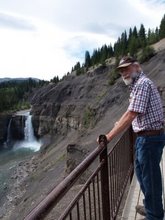

Elon Musk’s maternal grandfather, Joshua Norton Haldeman (1902–1974), was a Canadian chiropractor, aviator, and political activist whose views and affiliations have drawn significant historical attention—particularly for his leadership in fringe movements that opposed democracy, promoted technocratic rule, and later defended apartheid and antisemitic conspiracy theories.[1][2][3]
Early political involvement: Technocracy
In the 1930s–40s, Haldeman became a leading figure in Technocracy Incorporated, a movement that argued democracy and capitalism were obsolete and should be replaced by a “technate” run by scientists and engineers.[4][5][1]
- He rose to become the Canadian head of Technocracy Inc., adopting the member number “10450‑1.”[6][4]
- The movement was banned in Canada in 1940 after its U.S. leader opposed Canadian participation in World War II; Haldeman continued organizing and was arrested and convicted for belonging to an illegal organization.[2][3][5]
Shift to Social Credit and antisemitic conspiracy theories
As Technocracy waned after the war, Haldeman moved into the Social Credit Party in Canada, serving in leadership roles including national chairman.[3][5][1]
- The party’s early years included a strong antisemitic current; one of its newspapers printed the fraudulent Protocols of the Elders of Zion, which Haldeman publicly defended.[5][2]
- He advanced conspiracy narratives about “international financiers” (often coded as Jewish) controlling banks, media, and governments.[1][2]
Emigration to South Africa and defense of apartheid
In 1950, Haldeman left Canada for South Africa, citing dissatisfaction with Canadian governance and attraction to the new apartheid regime.[7][2][3]
- In South Africa, he wrote and spoke in support of apartheid, framing it as a bulwark of “White Christian Civilization” against an “international conspiracy” and “hordes of Coloured people.”[2][3][5]
- After the 1960 Sharpeville massacre, he published a self‑issued book defending the apartheid government and warning of outside invasion.[3][5]
Relation to Elon Musk
Musk has described his grandfather as a daring adventurer, and some observers note parallels between Musk’s technocratic outlook (e.g., engineer‑led governance ideas, efficiency drives like DOGE) and Haldeman’s Technocracy vision—though there is no direct evidence Musk adopted his grandfather’s extremist or racist views.[8][9][4][3]
- Claims that Haldeman was a Nazi Party member are not supported by documentary evidence; historians describe him instead as a technocrat, Social Credit activist, and later an apartheid defender with antisemitic conspiracy beliefs.[9][10][7]
If you’d like, I can outline how Technocracy’s proposals (energy accounting, 20‑year work span, continental “Technate”) map onto Musk’s recent governance ideas.
⁂
How Technocracy policies mirror Musk's plans
Technocracy’s core proposals and Elon Musk’s stated missions overlap in striking ways—especially the belief that complex societies should be run like engineered systems, that “first‑principles” physical metrics (energy, throughput) should replace politics and price signals, and that a small technical elite should make binding decisions to achieve civilizational goals.[11][12][13][14][15]
Below is a focused mapping of Technocracy policies to Musk’s plans and practices.
1) Rule by engineers vs. Musk’s “engineer-first” governance
Technocracy:
- Argued that democracy and the “Price System” (money, markets, politicians) were obsolete; power should reside in a board of technical directors and “functional sequences” run by scientists and engineers.[14][16]
- Society would be administered as a continental machine, optimized for throughput and stability rather than votes or profit.[17][14]
Musk parallels:
- Repeatedly frames government as slow and obstructive, while positioning himself and his teams as the ones actually running critical infrastructure: EVs and batteries, launch services, satellite internet, and increasingly AI.[18][19][11]
- At Twitter/X, he imposed an engineer-led, urgency-driven operating style: “all requirements are recommendations,” rapid reorgs, and top‑down technical mandates (e.g., mass server relocations) that treated the platform like a system to be re‑engineered rather than a public square governed by norms.[15][20]
- His DOGE-style rhetoric (cut waste, automate, measure everything) echoes the technocratic impulse to replace political bargaining with efficiency metrics and technical directives.[21]
2) Energy accounting vs. Musk’s energy-centric worldview
Technocracy:
- Proposed Energy Accounting: a non‑monetary system where the economy is measured in physical energy units; citizens receive energy certificates tied to net continental energy production, not money.[13][16][14][17]
- Wealth = capacity to convert and use energy; planning is done via continuous 24‑hour inventories of production/consumption to balance loads and eliminate scarcity.[13][17]
Musk parallels:
- Centers his civilizational mission on sustainable energy: Tesla (EVs, batteries, solar), Grid projects, and the claim that the transition to renewables is existential.[22][15][18]
- Thinks in physics-first terms (e.g., “idiot index” = finished cost vs raw materials; redesign to approach material limits), which mirrors Technocracy’s focus on physical flows rather than financial abstractions.[15]
- While he doesn’t propose abolishing money, his strategy treats energy and manufacturing capacity as the real bottlenecks to the future—consistent with a technocratic emphasis on physical throughput over monetary aggregates.[18][15]
3) Continental/planetary scale planning vs. Musk’s multiplanetary vision
Technocracy:
- Designed a North American Technate spanning the continent (and parts of Central/South America, Caribbean, Greenland), centrally planned for resources, transport, housing (“urbanates”), and production.[16][14][17]
- Emphasized centralized control of flow lines (materials, energy, goods) and standardized living environments to maximize efficiency.[14][13]
Musk parallels:
- Pursues planetary and multiplanetary infrastructure: Starlink (global internet), Tesla’s global factories, and SpaceX’s explicit goal of a self-sustaining city on Mars.[22][15][18]
- Treats Earth’s energy/transport system and Mars colonization as engineering projects requiring continent‑/planet‑scale coordination, not incremental policy—again reflecting the Technocratic scale of ambition.[23][11]
4) Abundance via automation vs. Musk’s push for full automation
Technocracy:
- Claimed mechanization could eliminate most jobs; proposed free housing, transport, education, and consumer goods as citizenship rights in a post‑scarcity Technate.[14]
- Sought to remove “money creation and distribution jobs” (banking, insurance) via centralized energy accounting and automation.[14]
Musk parallels:
- Bets heavily on automation and robotics: Tesla’s push toward full self‑driving and Optimus humanoid robots, factory automation, and AI that operates in the physical world.[24][18]
- Frames AI and robots as the path to an abundance economy where labor constraints dissolve—functionally similar to Technocracy’s promise of post‑scarcity through machines.[24][18]
5) Anti-political, mission-first urgency
Technocracy:
- Rejected party politics and electoral cycles in favor of technical administration guided by scientific planning and continuous measurement.[16][14]
Musk parallels:
- Organizes life around a few civilizational missions (sustainable energy, multiplanetary species, AI safety) and treats everything else as secondary or obstructive.[15][18][22][24]
- Operates with a “maniacal urgency” and willingness to override norms, regulations, and internal dissent to hit technical milestones—behavior critics liken to a modern captain-of-industry acting like a de facto planner.[19][20]
Where they diverge
- Mechanism: Technocracy proposed abolishing money and markets in favor of energy certificates; Musk works within capitalism, using markets, subsidies, and vertical integration to scale his systems.[13][15][14]
- Political program: Technocracy was an explicit anti-democratic political project; Musk’s influence is more indirect—shaping infrastructure, platforms, and policy debates rather than formally replacing institutions.[12][11][14]
- Scope of control: Technocrats envisioned a single continental authority; Musk controls multiple private empires that together touch many sectors but remain separate companies under his personal direction.[11][19][14]
If you’d like, I can sketch a side‑by‑side table of specific Technocracy design features (energy certificates, urbanates, functional sequences) against concrete Musk initiatives (Tesla energy ecosystem, Starlink, Optimus, X governance).
⁂
Explore the historical ties to his grandfather
Elon Musk’s historical ties to his maternal grandfather, Joshua Norman Haldeman (1902–1974), run through three channels: direct family storytelling in childhood, the ideological atmosphere of the household he grew up in (apartheid South Africa), and the continuity of certain worldview patterns—especially technocratic, anti‑political, and “civilizational mission” thinking—across the generations. [27][28][29][30][31]
Direct family influence: stories, slideshows, and role models
Musk never lived with Haldeman for long—their lives overlapped only briefly before Haldeman died in 1974, when Elon was three—but the grandfather remained a vivid figure in family lore. [27][31]
- As a child in Pretoria, Elon “heard many stories about his grandfather’s exploits” and sat through “countless slide shows” documenting Haldeman’s flights and expeditions, according to biographer Ashlee Vance. [27]
- Haldeman and his wife Wyn became minor celebrities for their aerial adventures (Canada → Africa → Australia in a small plane) and their obsessive search for the “Lost City of the Kalahari,” which they pursued on at least a dozen expeditions from the 1950s into the 1960s. [32]
- Elon’s mother, Maye Musk, repeatedly told these stories to her children, framing Haldeman as a daring, boundary‑pushing explorer. [27][29][32]
This created a family mythos in which risk‑taking, exploration, and “doing crazy things” were celebrated traits—traits Elon explicitly associates with his grandfather. [27]
The household and education environment: apartheid and Christian nationalism
Haldeman moved his family from Regina, Saskatchewan, to Pretoria, South Africa, in 1950, just as formal apartheid was being entrenched. [33][34][35][36]
- He publicly supported the National Party and defended apartheid as necessary for “White Christian Civilization,” writing and speaking against an alleged “international conspiracy” and non‑white majorities. [33][34][35][36]
- The Musk children grew up in a wealthy, white, apartheid‑era household where racial hierarchy was normalized, domestic labor was cheap and abundant, and the broader culture was steeped in Afrikaner Christian nationalism. [33][35][31]
- Elon attended Pretoria Boys High School and was educated in a system where Christian nationalist ideas shaped curricula and civic values, reinforcing an authoritarian, order‑first outlook. [33][35]
Historians and reporters argue this environment helped shape Musk’s comfort with hierarchical structures, his tendency to view societies as systems to be engineered, and his relative detachment from democratic norms. [33][30][31]
Ideological echoes: technocracy, anti‑politics, and civilizational missions
Haldeman’s pre‑South Africa career was defined by leadership in Technocracy Incorporated and later the Social Credit Party, movements that rejected conventional democracy in favor of rule by experts and conspiracy‑tinged critiques of finance and media. [27][28][37][38][36]
- In the 1930s–40s he was head of Technocracy in Canada, promoting a vision where scientists and engineers would govern a continental “Technate” using energy accounting instead of money and politics. [27][28][37][38]
- He later chaired the Social Credit Party nationally, defending antisemitic conspiracy literature like the Protocols of the Elders of Zion and railing against “international financiers.” [27][36]
Observers note several structural parallels between Haldeman’s outlook and Elon’s:
- Technocratic governance: Haldeman wanted a society run by technical elites; Elon’s companies effectively act as private technocracies, and his DOGE‑style proposals envision slashing bureaucracy in favor of efficiency metrics and expert control. [28][37][31]
- Anti‑political stance: Both treat elected politics as corrupt or obsolete, preferring direct action by capable individuals or small teams to re‑engineer civilization. [37][30][31]
- Civilizational mission: Haldeman framed his moves (Canada → South Africa) as defending a certain order; Elon frames Tesla, SpaceX, and AI ventures as existential projects to secure humanity’s future. [27][37][30]
Biographers and historians stop short of saying Elon shares his grandfather’s racist or antisemitic views; instead they highlight the continuity of technocratic, authoritarian, and mission‑driven patterns in a family that prized adventure, control, and elite problem‑solving. [28][36][30]
What’s documented vs. what’s speculative
- Well documented: Haldeman’s leadership in Technocracy and Social Credit; his public support for apartheid; the family’s move to South Africa in 1950; Elon’s exposure to family stories and slideshows; the apartheid/Christian nationalist environment of his upbringing. [27][28][34][29][36][32]
- Partly speculative: The degree to which Haldeman’s specific ideology directly shaped Elon’s adult beliefs. Biographers point to echoes and structural similarities, not a straight ideological inheritance. [28][37][30][31]
- Not supported: Claims that Haldeman or his wife were formal Nazi Party members in Canada; there is no documentary proof, though their views overlapped with far‑right and antisemitic currents of the era. [36]
If you’d like, I can map specific episodes from Haldeman’s life (e.g., Technocracy arrest, Kalahari expeditions, apartheid writings) to analogous moments in Elon’s career (e.g., regulatory clashes, Mars colonization push, X governance) to show the pattern more concretely.
⁂
- https://www.cbc.ca/newsinteractives/features/joshua-haldeman-elon-musk-saskatchewan-tech-utopian-conspiracist
- https://www.theatlantic.com/technology/archive/2023/09/joshua-haldeman-elon-musk-grandfather-apartheid-antisemitism/675396/
- https://ca.news.yahoo.com/ideological-adventures-elon-musks-saskatchewan-100039343.html
- https://www.vox.com/politics/400796/elon-musk-doge-trump-authoritarian-grandfather
- https://www.businessinsider.com/who-was-elon-musk-grandfather-joshua-haldeman-technocracy-incorporated-party-2023-9
- https://brian-sandberg.com/2025/04/04/on-the-technocratic-and-fascist-ideology-of-elon-musk/
- https://www.snopes.com/news/2025/01/29/musk-nazi-party-grandparents/
- https://www.lemonde.fr/en/economy/article/2022/04/19/twitter-elon-musk-s-latest-frontier_5980952_19.html
- https://www.distractify.com/p/elon-musk-grandparents
- https://mronline.org/2025/01/28/nazi-billionaires/
- https://www.newyorker.com/magazine/2023/09/18/elon-musk-walter-isaacson-book-review
- https://www.the-tls.com/lives/biography/elon-musk-walter-isaacson-book-review-henry-hitchings
- https://dn760106.eu.archive.org/0/items/EnergyAccounting.EnergyCetificates/TheEnergyCertificate-energyAccountingTecnocra.pdf
- https://technocracy.fandom.com/wiki/Technocracy_Incorporated
- https://grahammann.net/book-notes/elon-musk-walter-isaacson
- https://en.citizendium.org/wiki/Technocracy_Inc.
- https://www.scribd.com/document/815783916/TechnocracyInc-chq44-94-93-292007Information-3
- https://www.politico.com/newsletters/digital-future-daily/2023/09/13/elon-musks-theory-of-everything-00115723
- https://books.google.com/books/about/Elon_Musk.html?id=gBfXEAAAQBAJ
- https://www.kirkusreviews.com/book-reviews/walter-isaacson/elon-musk-ISAACSON/
- https://www.vox.com/politics/400796/elon-musk-doge-trump-authoritarian-grandfather
- https://www.latimes.com/entertainment-arts/books/story/2023-09-12/interview-with-walter-isaacson-about-his-biography-elon-musk
- https://time.com/6310076/elon-musk-ai-walter-isaacson-biography/
- https://english.elpais.com/usa/2023-09-11/walter-isaacson-biographer-elon-musk-has-multiple-personalities-at-times-hell-be-funny-others-he-gets-into-demon-mode.html
- https://www.latimes.com/entertainment-arts/books/story/2023-09-11/the-discerning-readers-takeaways-from-walter-isaacsons-elon-musk-biography
- https://s1.papyruspub.com/files/demos/products/ebooks/novels/biography/Preview-Elon-Musk-by-Walter-Isaacson.pdf
- https://www.cbc.ca/newsinteractives/features/joshua-haldeman-elon-musk-tech-utopian-conspiracist
- https://en.wikipedia.org/wiki/Joshua_Norman_Haldeman
- https://en.wikipedia.org/?title=X_Æ_A-12_Musk
- https://www.ynetnews.com/magazine/article/rknb92llt
- https://podcasts.apple.com/ky/channel/cbc-news-politics/id6471012891
- https://www.businessinsider.com/elon-musk-grandparents-kalahari-adventures-2016-8
- https://www.democracynow.org/2025/3/27/elon_musk_south_africa
- https://en.wikipedia.org/wiki/Joshua_N._Haldeman
- https://www.democracynow.org/2025/2/11/elon_musk_was_raised_under_racist
- https://ca.news.yahoo.com/no-proof-elon-musks-grandparents-120000770.html
- https://www.politico.com/newsletters/west-wing-playbook-remaking-government/2025/04/17/the-100-year-old-roots-of-elons-politics-00297608
- https://en.wikipedia.org/wiki/Draft:Joshua_Haldeman
- https://vocal.media/humans/elon-musk-l91j20u7u
- https://www.theatlantic.com/technology/archive/2023/09/joshua-haldeman-elon-musk-grandfather-apartheid-antisemitism/675396/
- https://ca.news.yahoo.com/ideological-adventures-elon-musks-saskatchewan-100039343.html


No comments:
Post a Comment