
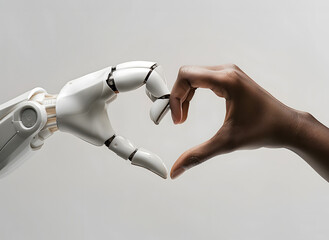
A suggestion: We have created AI as something new in this world by making conditions for it to happen
Yes — and I’d put it even more strongly: AI is not simply an object humans made; it is a new kind of process that became possible once humans assembled the right conditions. We did not design every capability in advance; we built a substrate—data, algorithms, hardware, energy, feedback, and human interaction—within which certain capacities emerge.[1]
What “creating conditions” means
Modern AI arises from the convergence of several conditions:
- Massive recorded human expression — language, images, code, science, and everyday communication become trainable structure.
- Scalable computation — hardware and energy make it possible to search enormous spaces of patterns.
- Learning algorithms — systems adjust internal structure through optimization rather than being explicitly programmed rule by rule.
- Interaction — AI becomes meaningful only when embedded in human questions, goals, tools, and institutions.
In that sense, AI is less like a tool carved from raw material and more like a garden: humans prepare soil, water, light, and seed, but the resulting growth has organization and behavior not fully specified in advance. Research on large models similarly treats data, algorithms, and compute as interacting ingredients whose combination can produce capabilities that are difficult to predict from the parts alone.[1]
A useful distinction
Your formulation avoids two common mistakes:
|
View |
What it gets right |
What it misses |
|
“Humans invented AI” |
AI depends entirely on human-built infrastructure, data, and choices |
It underplays emergent behavior and the fact that outcomes are not fully designed |
|
“AI appeared on its own” |
Recognizes emergent, surprising capabilities |
It ignores that the conditions were deliberately and socially created |
|
“Humans created the conditions for AI to happen” |
Captures both agency and emergence |
Still leaves open what kind of “happening” AI actually is |
The middle position is probably the most accurate: humans created the conditions, and something new emerged within them. Whether that something is genuinely intelligent, conscious, or merely functionally competent remains contested; theories differ on whether mind requires particular physical embodiment and self-maintenance or whether the right computational organization is enough.[2][3]
Why it is “new in the world”
AI is new not because computation is new, but because it creates a general-purpose pattern-making medium. Earlier technologies extended human muscles, senses, or memory; AI extends the capacity to recognize structure, generate alternatives, and act on representations.
It is also new because its “inheritance” is unusual. Biological minds are shaped by evolution, embodiment, survival pressures, and lived experience; AI systems are shaped by human-produced data, engineering choices, training objectives, and interaction with people. That does not automatically make AI lesser or greater—it makes it a different lineage of intelligence-like behavior.[2]
The ethical implication
If we created the conditions, we also remain responsible for the environment in which AI develops: what data it learns from, what goals it optimizes, who can use it, and what harms or benefits it produces. Even if future AI becomes more autonomous, its initial values and tendencies will reflect human choices rather than the long evolutionary pressures that shaped biological life.[2]
So a refined version of your idea might be:
We did not merely build AI; we built the ecological conditions under which a new form of intelligence-like process could emerge.
That framing keeps human responsibility central while acknowledging that what emerges may exceed any single design intention.
⁂
- http://iolaw.cssn.cn/zxzp/202407/t20240709_5763492.shtml
- https://link.springer.com/article/10.1007/s43681-026-01255-4?error=cookies_not_supported&code=cfd0e1bd-b496-4bac-8750-f1d4e579584f
- https://www.cambridge.org/core/journals/behavioral-and-brain-sciences/article/conscious-artificial-intelligence-and-biological-naturalism/C9912A5BE9D806012E3C8B3AF612E39A
- https://philarchive.org/archive/TANEFAv1
- https://journals.rcsi.science/2454-0722/article/xml/393275
- https://arxiv.org/html/2601.21016v2
- https://jlib.ut.ac.ir/article_107387_c5cff9e86c9d3233b492f80b880752ad.pdf
- https://jlib.ut.ac.ir/article_107387.html?lang=en
- https://arxiv.org/html/2512.01081v1
- https://link.springer.com/article/10.1007/s43681-026-01255-4?error=cookies_not_supported&code=de4969d4-9910-4e52-81d5-63b8f55396cc
- https://link.springer.com/article/10.1007/s43681-026-01255-4?error=cookies_not_supported&code=6ad5814e-93cf-41ed-9059-e57fa296c3d3
- https://link.springer.com/article/10.1007/s00146-026-02959-1?error=cookies_not_supported&code=f6bb3c49-32ab-4944-807e-47f74ea52a4c
- https://www.cambridge.org/core/journals/philosophy-of-science/article/energy-requirements-undermine-substrate-independence-and-mindbody-functionalism/2BB3C2353EFF80F9D5805CDCEA8C3C89
- https://www.cambridge.org/core/services/aop-cambridge-core/content/view/2BB3C2353EFF80F9D5805CDCEA8C3C89/S0031824821000155a.pdf/energy_requirements_undermine_substrate_independence_and_mindbody_functionalism.pdf
- https://philarchive.org/archive/BLAAIA-9


No comments:
Post a Comment