
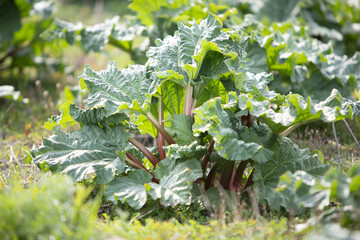
Its Ancient Origins
The first recorded medicinal use of rhubarb dates back to 2700 B.C. in China, where records document its roots being used for malaria, constipation, and fever with delirium. It is one of the oldest documented medicinal plants in the world. In Chinese tradition it is called Da Huang ("Great Yellow") — a reference to the vivid golden-yellow colour of its dried root — and it was first formally described in the Shennong Bencao Jing (Shennong's Classic of Materia Medica), the foundational TCM herbal text. It holds a place in that canon as a "lower-grade" herb, meaning potent and best used in acute conditions, not for daily tonic use.[1][2]
Traditional Chinese Medicine (TCM)
TCM regards rhubarb root as one of the most versatile and important herbs in the entire pharmacopoeia — sometimes called the "general" of herbs for its commanding, forceful actions. Unlike comfrey and horseradish, which lean toward topical/external or respiratory use, rhubarb is primarily an internal medicine with broad systemic effects. Its core TCM actions include:[3][4][5][2]
- Purging heat and stagnation — first-line treatment for constipation, excess heat in the intestines, and pathogenic toxin accumulation
- Cooling blood and stopping bleeding — nosebleeds, hematemesis (vomiting blood), uterine bleeding
- Clearing the liver channel — jaundice, liver disease, gallbladder disorders
- Resolving blood stasis — traumatic injuries, amenorrhea (absent menstruation), painful masses
- Treating toxic sores — boils, abscesses, erysipelas, burns (topically)
- Clearing heat from the eyes — conjunctivitis, red swollen eyes
It works along the spleen, stomach, large intestine, and liver meridians. TCM considers its flavour bitter and its energy cold — that cold-bitter quality is what gives it such a strong downward, clearing, and purging action. It was so prized that rhubarb commanded trade prices in medieval Europe three times higher than opium.[4][2][1]
Ayurvedic Medicine
In Ayurveda, the primary species used is Indian rhubarb (Rheum emodi), known by the Sanskrit name Pitamuli. It is primarily used to treat the Pitta dosha (fire/heat imbalance), reflecting the same cooling logic as TCM. Key Ayurvedic applications include:[6][7][8]
- Constipation and low digestion (root powder in hot water)
- Dysmenorrhea and uterine bleeding (cold infusion of leaves)
- Jaundice and hepatomegaly (liver swelling)
- Cough and rhinitis (root powder with honey)
- Wound healing (powdered root applied topically)
- Dental hygiene and gingivitis (root powder used as tooth powder)
- Intestinal worms, hemorrhoids, and abdominal bloating
Several classical Ayurvedic compound medicines include rhubarb as an active ingredient, including Kankayan Vati (for worms and piles) and Chiniumco tablets (for hemorrhage).[6]
Unani and Islamic Medicine
In Unani (Greco-Arabic) medicine — which flourished in Persia and Islamic civilization and shaped medieval European medicine — rhubarb was used for constipation, liver troubles, and purging bile and phlegm. Arab traders were likely the channel through which rhubarb root first reached Europe by the 8th–9th century A.D., and Marco Polo further introduced it to a wider European audience in the 13th century.[9][10][11][1]
How Rhubarb Compares With Comfrey and Horseradish
Feature | Comfrey | Horseradish | Rhubarb |
Primary system | Musculoskeletal, skin | Respiratory, digestive | Digestive, liver, blood |
TCM thermal quality | Cool/moist (Yin tonic) | Hot/warming (Yang) | Cold/bitter (purging) |
Ayurvedic dosha | Kapha-reducing | Pitta/Kapha clearing | Pitta-reducing |
Main route | Topical (now restricted internally) | Oral (food/medicine) | Oral (root/rhizome) [3][6][12][13] |
Oldest documented use | ~400 B.C. | ~1500 B.C. | 2700 B.C. [1][14][15] |
Safety concern | Pyrrolizidine alkaloids (internal) | Thyroid suppression in excess | Oxalic acid in leaves (toxic); root is safe [9][16] |
Rhubarb fits this context as the most ancient and most pharmacologically wide-ranging of the three. While comfrey heals tissue and horseradish clears the airways, rhubarb functions as a deep systemic cleanser — the great detoxifier, heat purger, and liver herb of the traditional world.[10][3]
⁂
- https://ipm.missouri.edu/meg/2016/3/Rhubarb-The-Pie-Plant/
- https://www.hjmedicalgroup.com/en/post/rhubarb-root-da-huang-a-potent-herb-for-clearing-heat-and-relieving-constipation
- https://pmc.ncbi.nlm.nih.gov/articles/PMC12558105/
- https://www.activeherb.com/blog/rhubarb-in-tcm-purging-heats-as-easy-as-pie.html
- https://www.mskcc.org/cancer-care/integrative-medicine/herbs/rhubarb
- https://www.easyayurveda.com/2017/03/29/rhubarb-rheum-emodi-pitamuli/
- https://www.planetayurveda.com/rhubarb-rheum-rhabarbarum/
- https://www.hindilanguage.org/indian-rhubarb/
- https://ask-ayurveda.com/wiki/article/5558-rheum-rhabarbarum--rhubarb
- https://www.metmuseum.org/perspectives/regal-rheums
- https://www.lrb.co.uk/the-paper/v14/n19/david-allen/homage-to-rhubarb
- https://www.ayurvedacollege.com/blog/california-college-of-ayurveda-learning-garden-comfrey/
- https://ausnaturalcare.com.au/health/life-style/herb-of-the-month-horseradish/
- https://horseradish.org/horseradish-history/
- https://corn.agronomy.wisc.edu/Crops/Comfrey.aspx
- https://www.ncbi.nlm.nih.gov/books/NBK548370/
- https://www.cambridge.org/core/journals/journal-of-global-history/article/abs/true-rhubarb-trading-eurasian-botanical-and-medical-knowledge-in-the-eighteenth-century/27C513BB012983F4173F73210677514E
- https://ayurwiki.org/Ayurwiki/Rheum_rhabarbarum_-_Rhubarb
- https://www.meandqi.com/knowledge-base/herbs/da-huang/
- https://en.wikipedia.org/wiki/Rhubarb


No comments:
Post a Comment