Wednesday, April 18, 2012

Creative advertising - west of Olds, Alberta

The Martians are coming!!


Closeup of Kelly's "Martian" with a drilling bit to chew you up!

Tuesday, April 17, 2012

Subdivision controversy dominates Clearwater County Open House

Division 1 Councillor Jim Duncan had the difficult task of hosting the open house in the Hardindell Hall

Story and Photos by Helge Nome


As part of its outreach to the community, the Clearwater County Council hosted an open house with beef-on-a-bun at the Hardindell Hall, south-west of Rocky Mountain House, on April 11. Council members and staff made themselves available to respond to community interest in county affairs. There was a good turnout of residents and some heated discussion following the meal, mainly centered around the local Meadow Ponds 54 lot subdivision proposal.

The meeting was hosted by the area's elected councillor, Jim Duncan, who made a presentation and responded to written questions from the floor. Duncan expressed the need to diversify the county economy to move away from the current 85% of taxation revenue coming from the oil and gas industry. Balanced growth and retention of youth are priorities for the present council. A sewage lagoon and a hospital are currently needed in the area, according to Duncan.

Following a break, Duncan responded to questions from the floor and noted the problem with the use of off-road vehicles in the west country and emphasized the need for cooperation between the RCMP, Sustainable Resource Development and County Peace Officers in minimizing damage to the environment.

However, most of the questions were focussed on the controversial Meadow Ponds subdivision proposal. Former area County Councillor Ken Qually and area resident Rob Dewling were particularly vocal in their opposition to the recent County Council decision to re-designate the 154 odd acres involved from "agricultural" to "country residential". Both individuals stood up and argued that the county had ignored provisions of its own municipal development plan and land use bylaw in its 4-3 decision in favor of re-designation. This was denied by County Manager Ron Leaf and Reeve Pat Alexander.

A controversial aspect of this subdivision proposal is an offer by the developer to "gift" three areas of the farm quarter to be subdivided back to the County. This consists of land suitable for agriculture. If these areas were included in the development proposal, the whole quarter section of land should not even have been considered for subdivision, according to the Municipal Development Plan which states that:" the land on which the residential subdivision is proposed has a Farmland Assessment Rating of 34% or less, except that up to 15% of the land to be subdivided for residential purposes may have a higher rating.

The quarter in question has more than twice the allowable percentage of quality land.
For some photos of the protagonists in action, go to Second Page

Monday, April 16, 2012

PCs misleading Alberta landowners about loss of land rights

Press release

Alberta Landowners Council wants landowners to know the truth before they vote

APRIL 20, 2012—Morinville, AB The Alberta Landowners Council says the PC candidates must be feeling the heat on property rights and the controversial Bills 24, 36 and 50.
The council points to a number of PC candidates taking out paid advertisements in local
newspapers and candidates emphasizing property rights in all-candidate forums.

“The paid ads include claims about the candidate’s admiration of property rights as well as emotional descriptions of their family histories involving land ownership,” says council president, Colleen Boddez.

Boddez cites ads taken out by Barrhead-Westlock PC candidate Maureen Kubinec as well as
Stettler-Drumheller MLA Jack Hayden. The PC candidates are also claiming at all-candidate forums that ‘the three ‘Cs’ of consultation, compensation, and the courts’ fix the problems with the land bills that have upset so many Albertans.

However, the Alberta Landowners Council says the PC assurances are simply not
accurate.“They are also bragging about creating a new government position called the property rights advocate under Bill 6. Yet our legal review confirms that Bill 6 gives the new advocate no powers—none,” notes Boddez.

Keith Wilson, a land rights lawyer and the council’s policy chair found that Bill 6 does not contain any legal provisions to address the harmful effects of Bills 24, 36 and 50 on landowners and resource users.

Caroline's Kurt Browning Arena will be upgraded


Photo and story by Helge Nome

The Kurt Browning arena in Caroline, named after the area's famous figure skater, will receive upgrades in the form of additional change rooms to be constructed along the sloping west side (seen in photo) and the renovation of the existing change rooms and lounge.

The Clearwater County Council was informed about progress on this project at its regular meeting on April 10 by staff who said that John Murray Architectural Associates is in the process of being hired for engineering services.

The million dollar project will be overseen by Clearwater County staff based on, in part, a $500,000 grant to the Village of Caroline from the Government of Alberta.
The winning bid for engineering services came in at $54,800. The same firm was successfully used to oversee the expansion of the Westview Seniors' Lodge in Rocky Mountain House.

Rocky Mountain House - Development or stagnation?

The Town of Rocky Mountain House in West Central Alberta has a rich history, going back to the fur trading era. It also has a problem:

By Helge Nome

At its regular meeting on April 10, the Clearwater County Council received a delegation from the Rocky Mountain House and District Chamber of Commerce in regard to stagnating economic activity in the area, with shoppers taking their money elsewhere.

The chamber group, Cindy Taschuk, Judy Richardson and Shirley Sellers, presented a plan for bringing shoppers back to the community which involves attracting an "anchor store", like Target, setting up shop in the town. This would meet an identified need for an outlet for clothing, shoes, children's toys, gifts and sporting goods.

Rocky was compared to other similar communities, like Drayton Valley, Olds, Stettler and Vegreville, all of which have benefited financially from big box stores coming in.
Rocky came up short and it was noted that a lot of the business from native people in the area had moved to Drayton Valley. Local people also find Sylvan Lake to be a convenient shopping location, avoiding the hustle and bustle of the City of Red Deer.

In order to inform local business people about the adjustments needed, on their part, to accommodate an anchor store, the delegation asked the County Council to consider help paying for a consultant to come into the community with pertinent advice. The amount involved would be in the range $3,500 - $5,000.

Reeve Pat Alexander responded by saying that the Rocky Chamber should include the Caroline & District Chamber of Commerce in the planning and execution of its agenda, as there is a history of cooperation between the Town of Rocky, Village of Caroline and Clearwater County. The delegation agreed to do this and the project remains a work in progress.

Propaganda's founding father, Edward Bernays


Editor: The Book, "Propaganda" presented in this video is available on line. A bit of an eye opener

Sunday, April 15, 2012

Washington’s bizarre Kosovo strategy could destroy NATO

State Secretary Clinton at a press conference in Washington D.C. with Kosovo Prime Minister Hashim Thaci, 9 April 2012.
Photo: EFE / END

By F. William Engdahl

(Editor - This article provides an excellent opportunity to see a side of the coin that will never appear in the mainstream media)


Not satisfied with having sponsored the artificial creation of Kosovo, the United States has now decided to ram the mafia state through NATO and the European Union. A new member with those characteristics is the last thing that Europe needs right now. However, it should work wonders for the consolidation of U.S. political and military agenda in the region, not to speak of the flourishing heroin trade from Afghanistan...both of which, as Engdahl points out in this sharp analysis, pose a threat to Russia and may backfire in the end.


In one of the more bizarre foreign policy announcements of a bizarre Obama Administration, US Secretary of State Hillary Clinton has announced that Washington will “help” Kosovo to join NATO as well as the European Union. She made the pledge after a recent Washington meeting with Kosovo Prime Minister Hashim Thaci in Washington where she praised the Thaci government’s progress in "European integration and economic development" [1].

Her announcement no doubt caused serious gas pains among government and military officials in the various capitals of European NATO. Few people appreciate just how mad Clinton’s plan to push Kosovo into NATO and the EU is.

Basic Kosovo geopolitics

The controversial piece of real estate today called Kosovo was a part of Yugoslavia and tied to Serbia until the NATO bombing campaign in 1999 demolished what remained of Milosevic’s Serbia and opened the way for the United States, with the dubious assist of EU nations, above all Germany, to carve up the former Yugoslavia into tiny, dependent pseudo states. Kosovo became one, as did Macedonia. Slovenia and Croatia had earlier split off from Yugoslavia with a strong assist from the German Foreign Ministry.

Some brief review of the circumstances leading to the secession of Kosovo from Yugoslavia will help locate how risky a NATO membership or EU membership would be for the future of Europe. Hashim Thaci the current Kosovo Prime Minister, got his job, so to speak, through the US State Department and not via free democratic Kosovo elections. Kosovo is not recognized as a legitimate state by either Russia or Serbia or over one hundred other nations. However, it was immediately recognized when it declared independence in 2008 by the Bush Administration and by Berlin.

Membership into the EU for Kosovo would be welcoming another failed state, something which may not bother US Secretary Clinton, but which the EU at this juncture definitely can do without. Best estimates place unemployment in the country at as much as 60%. That is not just Third World level. The economy was always the poorest in Yugoslavia and today it is worse. Yet the real issue in terms of the future of EU peace and security is the nature of the Kosovo state that has been created by Washington since the late 1990’s.
Continue reading article here

Saturday, April 14, 2012

Peaceful atom for distant space missions

Soviet and now Russian rocket scientists have been working on nuclear rocket engines for more than 50 years already. Similar developments have been conducted by their colleagues in the US. There are two types of nuclear rocket engines.


by Sergei Mizerkin
Moscow (Voice of Russia) Apr 16, 2012


According to Russia's Nuclear Agency (Rosatom) the nuclear power and propulsion installation of the megawatt-class is to be built by 2017. The assembly will start already next year, first units of the installation. The development and construction of the nuclear installation will cost more than $247 million.

In the very beginning of the space era it was clear that it was impossible to launch space mission far from Earth using traditional chemical engines. The liquid and solid fuel powered engines, which are used now, have low technical and economic indicators, Alexander Zheleznyakov, academician with the Tsiolkovski Space Academy says.

"By now we have used almost all the potential of the chemical engines. It takes a very long time to accomplish a space mission to distant planets. Such missions are launched quite seldom and only relatively light and small spacecrafts can be used for such missions. The creation of nuclear rocket engine will enable us to significantly broaden our studies of the Solar system and may be also our possibilities to send missions to distant stars."

Soviet and now Russian rocket scientists have been working on nuclear rocket engines for more than 50 years already. Similar developments have been conducted by their colleagues in the US. There are two types of nuclear rocket engines.

The first type is impulse nuclear engine in which thrust is created by means of several blast of nuclear fuel. Tests proved that impulse nuclear engines have no prospects. The first prototypes of nuclear engines were built in the mid 1960s.

These were Soviet RD 0401 and American NERVA engines. In both engines the same principle was used: a working body (liquid hydrogen) was heated in nuclear reactor, and during the exhaustion thrust was created.

Though they were improved they were not used due to the high risk of nuclear reactor blast, which could be caused by overheating and due to high "exhaustion" of radioactivity. There were many accidents and emergency situations cased by satellites equipped with nuclear installations, head of the department of the Space Research Institute Yury Zaitsev says.

"We had a lot of accidents caused by these engines. Americans also had them. For example during the launch of the US Transit satellite - it burned above the Indian ocean and almost 1 kg of plutonium-238 was spread in the air. Later Soviet Kosmos 954 satellite fell on the territory of Canada contaminating the area of about 60,000 square meters."

But the new development solves the security issue. Spacecrafts will use ion electric reactive engines in which thrust is created by means of flow of ions, which are speeded up by an electric field. Nuclear reactor onboard of the station will fuel the engine and won't exhaust radioactive substances into the environment.
(My emphasis - Editor)

"Currently our space vehicles are using the energy generate by solar batteries. But they can operate only on the orbits close to Earth and can't be used for distant missions. That is why nuclear installations have a number of advantages in terms of capacity."

It is planned that nuclear energy installations will boost unmanned scientific spacecrafts which are sent to distant planets. In the future it may become possible to apply nuclear technology in spacecrafts which carry astronauts.

Source: Voice of Russia

Friday, April 13, 2012

Caroline Municipal Library news


By Amanda Archibald

Spring has sprung at the Caroline Municipal Library! With the welcome of spring, we have a wonderful program line-up!

Thursday Night at the Library 7:00-8:30pm:

Thursday, April 26, 2012: Gardening Frenzy: spring is here. Let’s get out into the fresh air and start gardening. Ursula Schroeder from Dragonfly Greenhouses will share gardening tips.

Thursday, May 17, 2012: Toxic Free Clean Home: Pat Warkentin will talk about creating your own household cleaning products from everyday ingredients. Cut down costs, cut down on toxic, allergy causing chemicals around your home.

Thursday, June 14, 2012: Natural Supplement Myths: Local pharmacist, Leanna St Onge, will talk about natural supplements and common myths about naural products and herbal remedies.


StoryTime will continue to run Thursday mornings from 10:00-11:00am until the end of May. Also new to the library this year, we are offering our patrons the chance to try out our new e-readers, which are available for check-out!
We hope to see you come through our doors!

Thursday, April 12, 2012

Europe's banks beached as ECB stimulus runs dry

'There has been no transfer of risk to the ECB's own balance sheet, which is what we think is needed to take away the tail-risk of another EMU blow-up' Photo: Alamy


By Ambrose Evans-Pritchard

8:19PM BST 11 Apr 2012


The European Central Bank's €1 trillion (£824bn) lending spree over the winter has stored up a host of fresh problems, leaving parts of the banking system more vulnerable than before as the short-term "sugar rush" nears exhaustion.


Credit experts say the Spanish and Italian banks are trapped with large losses on sovereign bonds bought with ECB funds under the three-year lending programme, or Long-Term Refinancing Operation (LTRO).

Andrew Roberts, credit chief at RBS, said Spanish banks used ECB funds to purchase five-year Spanish bonds at yields near 3.5pc in February and 4.5pc in December. The same bonds were trading at 4.77pc on Wednesday, implying a large loss on the capital value of the bonds.

It is much the same story for Italian banks pressured into buying Italian debt by their own government. Any further dent to confidence in Italy and Spain over coming weeks – either over fiscal slippage or the depth of economic contraction – could push losses to levels that trigger margin calls on collateral.

"The banks are deeply underwater. This is turning into a disaster for the eurozone periphery now that the liquidity tap has been turned off," said Mr Roberts. "But given the opposition in Germany, the ECB can't easily do another LTRO until there is a major crisis."

Spanish banks bought €67bn of sovereign debt between December and February, while Italian banks bought €54bn. The purchases almost certainly continued in March. These lenders have soaked up most of debt issues in their countries over the past three months, picking up at a juicy return under the "carry trade" while at the same acting as a conduit for the ECB to shore up crippled countries by the back-door.
Article continues here

Saturday, April 7, 2012

Vimy Ridge Day recognized at the Caroline Legion

On April 9, 1917 – Easter Monday – at 5:28 am the battle was engaged.


Caroline Legion members Bobbi Jo Noirot and Terry McGuire made a presentation to other members and guests.

Photos and story by Helge Nome

The popular Friday night supper at the Caroline Legion on April 6 was combined with the recognition of the significance of the April 9 date in Canadian history:

"On the morning of April 9, 1917 the Canadian Corps attacked the German stronghold position at Vimy Ridge. The ridge, located about 10 kilometres to the north of Arras in Northern France and just south of the mines and factories of Lens and Lille, was a high ground that commanded the entire sector.

The Canadian Corps, comprising of the Canadian 1st, 2nd, 3rd and 4th Divisions united for the first time – over 100,000 men - was attempting to do what the British and French forces had tried from 1914 to 1916. Their attacks had gained little other than 130,000 casualties."
For more details, check out this website

Veteran UN peacekeeper, Terry McGuire, made the following presentation to the audience:

" Ladies and Gentlemen, may I please have your attention for a few minutes. Tonight is not only the Legion's weekly Friday night supper, but is also the Eve of a remarkable event in our country's history.
For the full story with more photos, got to Second Page

Elephant Face on Mars


NASA / JPL / University of Arizona

A lava flow in Mars' Elysium Planitia region takes on the appearance of an elephant in this picture from the HiRISE camera on NASA's Mars Reconnaissance Orbiter, captured on March 19 and released April 4.

Friday, April 6, 2012

Hi! My name is Bruno


"I'm the big daddy of a lot of the dogs here"

This one is pretty good!

Star Wars Subway Car

Re-inventing rural Alberta - neat graphics

Suicide note - from Greece


Here is a translation of the note left by Dimitris Christoulas, the 77-year-old retired pharmacist who committed suicide in the middle of Syntagma Square on 4 April:

"The occupying Tsolakoglou government has annulled even the last means of my survival, a dignified pension funded by me alone (without any support from State) for 35 years of my life.

Given that my age does not grant me the individual possibility of a forceful reaction (although if a fellow Greek were to grab a Kalashnikov, I would be right behind him) I see no other solution than a dignified end, before I start picking up the garbage to find something to eat.

I believe that our youth with no future, will one day pick up their arms and hang the traitors of this Nation upside down at Syntagma square, just like the Italians did to Mussolini in 1945 (Piazza Loreto, Milan)."

Notes: Georgios Tsolakoglou was appointed Prime Minister of a collaborationist government by the Axis Occupation authorities on 30 April 1941. He served until 2 December 1942, when he was replaced by Konstantinos Logothetopoulos. After Greece was liberated, Tsolakoglou was arrested, tried by a Special Collaborators Court in 1945, and sentenced to death. His death penalty was ultimately commuted to life imprisonment, and he died in prison in 1948. Syntagma (Constitution) Square is located in central Athens and is named after the Constitution that King Otto was forced to grant to the people, after a popular and military uprising on 3 September 3 1843. Benito Mussolini and his mistress Clara Petacci, along with most of the members of their entourage, were executed by partisans on 28 April 1945 in the small village of Giulino di Mezzegra. The next day, their corpses were trucked to Milan and then hung upside down on meathooks from the roof of an Esso gas station on Piazza Loreto.
Original article posted here

False Flag Attack


By Paul Craig Roberts


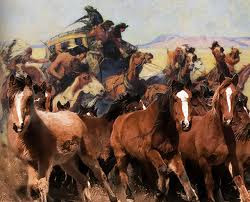
The stagecoach bounced along the uneven trail through Indian lands. A year ago there would have been danger from Indians. But Ulysses Grant had sent General Philip Henry Sheridan, who had brought the horrors of war to Confederate civilians, to annihilate the plains Indians.

In his winter campaign of 1868-69, Sheridan attacked the Cheyenne, Kiowa, and Comanche tribes in their winter quarters, killing women and children and taking the Indians' supplies and livestock. In Congressional testimony, Sheridan advocated the slaughter of the vast herds of bison in order to deprive Indians of food. Having turned professional hunters loose on Indian lands, Sheridan wrote: "Let them kill, skin and sell until the buffalo is exterminated." For his proficiency in war crimes, Sheridan was made commanding general of the U.S. Army.

When the first thud of the arrows hit the stage, the passengers screamed, "Indians, we will be scalped." Among the passengers was a grizzled, hardened man. He retrieved an arrow and noting the metal arrowhead realized that it was not an Indian arrow and that the stage was being attacked by outlaws posing as Indians.
Read insightful article here

Thursday, April 5, 2012

Grocery Store Musical

Sundre Petroleum Operators Group hosts community meeting on Hydraulic Fracturing


Text and photos by Helge Nome

The Sundre Petroleum Operators' Group represents an attempt by the oil and gas industry and local landowners to bridge the traditional gap between their interests. It covers an area in the western foothills of Alberta which includes the Town of Sundre where a lot of oil and gas extraction is carried out, including highly toxic sour gas. In recent times new extraction technology has included the use of hydraulic fracturing which can have negative impacts on surface and groundwater used by local residents. This has created new tensions between land owners and the industry.

In consequence, a public meeting was hosted by SPOG in the Eagle Hill Community Hall on Tuesday, April 3 under the guidance of SPOG Executive Director Tracey McCrimmon who introduced the speakers: Clive Mountford from NAL Resources, Christa Seaman from the Canadian Association of Petroleum Producers and Bob Willard from Alberta's Energy Resources Conservation Board.

The audience was, unfortunately, primarily composed of industry and government representatives with very few community people having showed up. This may have been due to a communications problem. Those residents that did show up were very unhappy about developments to date, in spite of assurances of low risk from the industry speaker during a panel question and answer session. A recent blow-out of "fracking" fluids from an old well adjacent to a new one where high pressure hydraulic fracturing was taking place brought home the inherent risks of the operation in areas of old wells intersecting the some 2000 meter deep formation from which oil and other fluids, along with gas, are being extracted.
For photos of speakers and more comments, go to Second Page

Good morning!

Wednesday, April 4, 2012

Is Economics a science?


By Helge Nome

Have you folks heard about John Nash and his Nobel Prize in "Economic Sciences" ( a very questionable concept in itself)? I have watched the video "A Beautiful Mind" created as a tribute to him based on a novel by Sylvia Nasar with the same title.
Then I watched a real interview with the guy after he received his Nobel Prize.
He came across as totally dull and uninteresting and I had a hard time trying to figure out what all the fuss was about.
I think I have an idea:
This is what he and his two colleagues got the prize for:

"The Sveriges Riksbank Prize in Economic Sciences in Memory of Alfred Nobel 1994 was awarded jointly to John C. Harsanyi, John F. Nash Jr. and Reinhard Selten "for their pioneering analysis of equilibria in the theory of non-cooperative games"." (My emphasis)

This is the cornerstone of neoclassical economics: Just leave the gamers alone and things will stabilize automatically.
Is it possible that this theory was used as a rationale for deregulating banking and letting the fraudsters have free reign?

Tuesday, April 3, 2012

Exploding kitchen tiles in school cafeteria, Watertown, Wisconsin


Editor: This is part of an ongoing phenomenon in Wisconsin where the very earth is grumbling under peoples' feet

Monday, April 2, 2012

Pantless journey

Cool video

Musings on banking


By Helge Nome

The big question is whether bank deposits are re-lent to borrowers, or invested in financial instruments, as the case may be, or are simply parked in limbo while new money is created in the form of loans to bank customers.

I think the problem is embedded in the language we use to describe transactions where "money" is seen as some kind of entity moving around from here to there. Except for currency, this is patently not the case. Deposits and withdrawals are simply accounting
entries following accepted rules and conventions. So, in reality, there is no great pile of deposits that are moved to other places to become deposits there, at the expense of a diminishing pile at source. There are simply diminishing numbers at source balance sheets as compared to increasing numbers on destination balance sheets.

The sneaky part about bank balance sheet numbers is this: New loans appear as assets to the bank in the asset column and as deposits in the liabilities column. These deposit entries in the liabilities column are not distinguished from deposits from sources external to the bank. So when you read the bank's consolidated balance sheet it appears as if something like 90% of deposits have been issued as loans.
The assumption made by an outsider is that the bank has re-lent about 90% of its deposits (hanging on to 10% in case someone comes back for their money). The reality is, of course, that a substantial number of those deposits were made out of thin air by way of internal accounting entries.

All that said, people use banks to park their money in a safe place and expect some interest return on their money. So if banks accept the stuff (which normal banks have to do) they have to find some way of generating money to cover this interest plus some profit for themselves. Ergo, rules are created which enable them to do so because they fill a very real need in society. However, in order to appease public sentiments, it is important to generate the illusion that banks re-lend money placed in their vaults at a marginal increase in interest rate.

I tried my hand as an illusionist (magician) in my young days. The crafts of magic and banking have many traits in common.

A sad tale - inequality in Europe


Please click on images for a better view
For more information, click here

Oh Canada! Imposing Austerity on the World’s Most Resource-rich Country


By Ellen Brown

Even the world’s most resource-rich country has now been caught in the debt trap. Its once-proud government programs are being subjected to radical budget cuts—cuts that could have been avoided if the government had not quit borrowing from its own central bank in the 1970s.

On March 29 in Ottawa, the Canadian House of Commons passed the federal government’s latest round of budget cuts and austerity measures. Highlights included chopping 19,200 public sector jobs, cutting federal programs by $5.2 billion per year, and raising the retirement age for millions of Canadians from 65 to 67. The justification for the cuts was a massive federal debt that is now over C$ 581 billion, or 84% of GDP.

An online budget game furnished by the local newspaper the Globe and Mail gave readers a chance to try to balance the budget themselves. Possibilities included slashing transfer payments for elderly benefits, retirement programs, health benefits, and education; cutting funding for transportation, national defense, economic development and foreign aid; and raising taxes. An article on the same page said, “The government, in reality, doesn’t have that many tools at its disposal to close a large budgetary deficit. It can either raise taxes or cut departmental program spending.”

It seems that no gamer, lawmaker or otherwise, was offered the opportunity to toy with the number one line item in the budget: interest to creditors. A chart on the website of the Department of Finance Canada titled “Where Your Tax Dollar Goes” showed interest payments to be 15% of the budget—more than health care, social security, and other transfer payments combined. The page was dated 2006 and was last updated in 2008, but the percentages are presumably little different today.
Continue reading article here