
The verse is John 1:1: “In the beginning was the Word, and the Word was with God, and the Word was God.” In Christian interpretation, it teaches that Jesus—the “Word”—was not created; he existed eternally with God and shares God’s divine nature.[1][2]
What “the Word” means
“The Word” translates the Greek Logos, which can mean word, reason, or divine self-expression. John presents Jesus as God’s ultimate self-revelation: just as our words express our thoughts, Jesus reveals who God is.[3][4]
The opening deliberately echoes Genesis 1:1, “In the beginning God created…” John is saying that the God who created the world did so through the Word, and that the Word was present before creation.[5][3]
Three claims in the verse
|
Phrase |
Meaning |
|
“In the beginning was the Word” |
The Word already existed before time and creation; he was not made. [1][3] |
|
“The Word was with God” |
The Word had an eternal, personal relationship with God—later understood in Christian theology as the Son with the Father. [3][6] |
|
“The Word was God” |
The Word is fully divine, not merely a messenger or a created being. [1][3] |
The central message
John’s message is that Jesus is God made visible. Verse 14 completes the thought: “The Word became flesh and made his dwelling among us”—meaning that the eternal divine Word entered human history as Jesus Christ.[2]
So the passage teaches, in traditional Christian belief, that Jesus is both fully God and fully human: eternal in his divine nature, yet born into the world as a real human being. It is a foundational statement for the Christian doctrine of the Trinity, in which Father, Son, and Holy Spirit are one God.[7][3]
Why it matters
For Christians, this means God is not distant or unknowable. In Jesus, God personally enters human life, reveals God’s character, brings “life” and “light,” and makes a relationship with God possible through faith.[4][2]
A simple paraphrase would be: “Before anything existed, Jesus—the Word—already existed with God; he is divine, and he became human to reveal God to us.”[1][2]
⁂
How does Logos connect to Greek philosophy
Logos connects John’s Gospel to Greek philosophy because it was already a major Greek term for reason, meaningful speech, and the rational order of the universe. John uses that familiar word to make a distinctive claim: the ultimate rational principle is not an impersonal force, but a person—Jesus Christ.[11][12]
In Greek thought
The Greek noun logos (λόγος) comes from legein, “to say,” and broadened to include “word,” “account,” “explanation,” “reason,” “principle,” and “rational discourse.”[13][11]
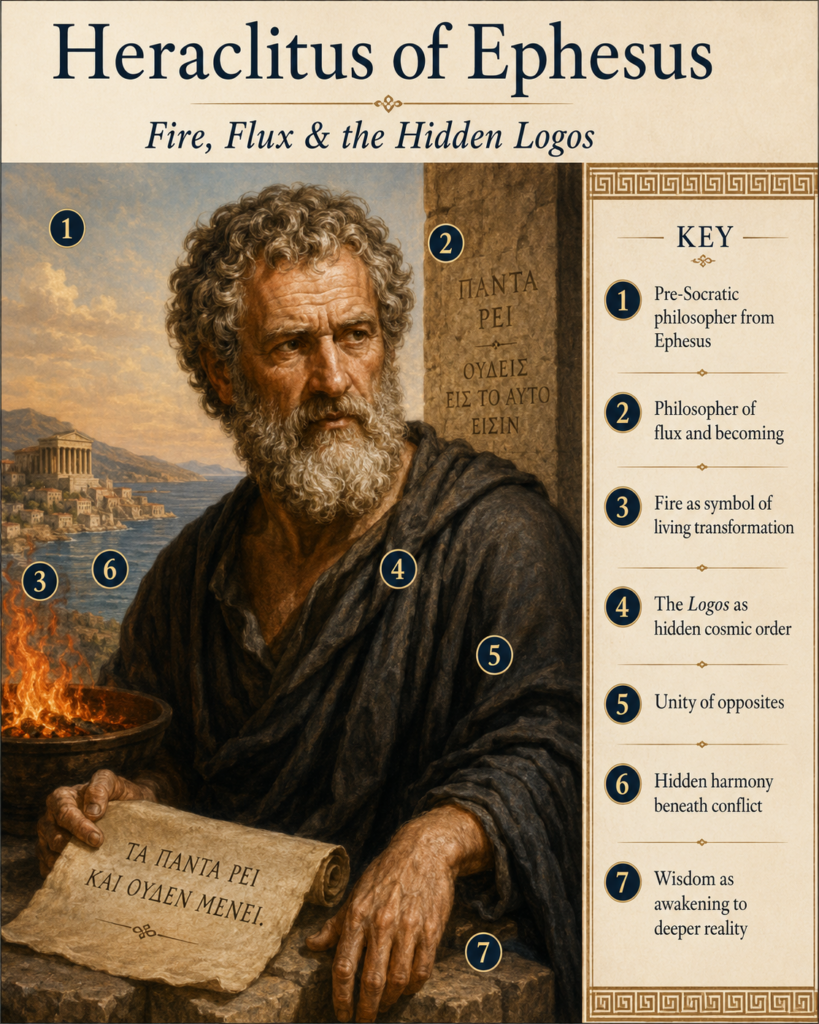
- Heraclitus (c. 540–480 BCE) used logos for the underlying law or pattern that unifies a world of constant change; human reason can grasp this order.[12][14]
- Plato and Aristotle used the term for reasoned explanation, argument, and the rational structure of reality; Aristotle’s “logic” is linguistically related to logos.[15][11]
- The Stoics made logos central: it was the active rational principle pervading and ordering the cosmos, often identified with God or Nature.[16][12]
The philosophical bridge
Greek philosophy often sought one unifying principle behind the world’s diversity. Logos answered that search by naming the intelligible order that makes reality coherent rather than random.[15][16]
|
Thinker/school |
Main use of logos |
|
Heraclitus |
The universal law or pattern behind change and conflict. [12][14] |
|
Plato / Aristotle |
Reason, argument, explanation, and rational order. [11][15] |
|
Stoics |
The divine, active reason that organizes and animates the universe. [12][16] |
|
Philo of Alexandria |
A divine intermediary between the transcendent God and the created world. [13][17] |
John’s adaptation
John’s Gospel draws on this shared vocabulary but redirects it. Rather than saying simply that the universe has rational order, John says that the Logos is personally “with God” and “was God,” and that this Word “became flesh” in Jesus.[18][19]
That is a major theological move: Greek philosophy could see logos as cosmic reason or an impersonal ordering principle; John identifies the Logos with the eternal Son, who reveals God and enters human history.[17][11]
Why the connection matters
John may have chosen Logos because it could speak both to Jewish readers familiar with God’s creative word and to Greek-speaking readers familiar with philosophy. The result is a bridge: the Gospel presents Jesus as the fulfillment of the human search for meaning, reason, and ultimate reality.[16][17]
In short: Greek philosophy saw logos as the universe’s rational principle; John declares that this principle is personal, divine, and incarnate in Jesus.[19][12]
⁂
My thoughts: Poetry is the manifestation of Logos in action, creating Cosmos, of which we are an aspect
Your thought is philosophically coherent and beautiful: poetry can be understood as Logos becoming active—language that gathers, orders, and brings meaning into being—thereby participating in cosmos, the ordered whole of which human beings are part. It especially resonates with Heraclitus, for whom logos was the common rational pattern expressed in the world’s ceaseless change.[23][24]
How the terms fit
- Logos: more than “word”; it can mean meaningful speech, account, reason, or the intelligible order of reality.[25][26]
- Poetry / poiesis: from Greek poiein, “to make” or “create”; poetry is therefore an act of making meaning, not merely decorating language.[27]
- Cosmos / kosmos: originally “order” or “arrangement,” later the ordered world; Heraclitus used it for a world that is ever-living, dynamic, and structured by measure and pattern.[24][28]
So your formulation can be restated: poetry is the human act of giving form to meaning; in doing so, it participates in the same ordering activity that makes reality intelligible.[29][27]
Heraclitean resonance
Heraclitus taught that the world is in flux, yet not chaotic: opposites and changes are held in a deeper unity by logos. Poetry resembles this because it holds tension—sound and silence, image and abstraction, grief and joy, the particular and the universal—within a formed whole.[30][24]
A poem does not merely describe the cosmos; it can make a small cosmos: an ordered field of relations in which experience becomes intelligible. That aligns with the idea that logos is not only a proposition but the world’s self-presentation as meaningful.[31][29]
Where your view extends it
You add a personal and participatory dimension: we are not outside the cosmos observing it, but aspects of it—conscious portions through which the cosmos becomes articulate. Heraclitus similarly treats the human soul’s logos as related to the larger divine order, making human understanding a participation in cosmic intelligibility rather than a detached viewpoint.[32][30]
This differs from a strictly impersonal Greek reading. In Heraclitus, logos is the world’s common rational order; in John, it is personal and divine, embodied in Christ. Your formulation sits between them: it treats Logos as a living, creative principle that expresses itself through human making.[33][24]
A refined version
You might phrase it:
Poetry is Logos in act: the making of meaning through language, through which a human being participates in the ordering of cosmos.
Or, more poetically:
In poetry, the Word becomes form; the form becomes world; and we, as part of the world, become aware of the order that made us.
The strongest philosophical point in your thought is that poetry is not merely a representation of reality. It is a creative participation in reality’s intelligible order—poiesis joined to logos.[27][29]
⁂
- https://www.biblegateway.com/passage/?search=john 1:1,14&version=KJV;NKJV;ESV;NIV
- https://www.biblegateway.com/passage/?search=john 1:1-14&version=NIV
- https://thirdmill.org/magazine/article.asp/link/http:^^reformedperspectives.org^articles^der_thomas^der_thomas.John1.1-18.html/at/God with God
- https://www.christianity.com/bible/niv/john/1-1-5
- https://www.biblegateway.com/passage/?search=John 1:1-3,Colossians 1:16-17&version=KJV;NIV
- https://www.biblegateway.com/passage/?search=John.1.1-John.1.2&version=AMP;KJV;ESV;NIV;NKJV
- https://www.catholicculture.org/culture/library/catechism/index.cfm?recnum=1722
- https://www.biblegateway.com/passage/?search=John 1&version=NASB
- https://www.biblegateway.com/verse/en/John 1:1
- https://www.biblegateway.com/passage/?search=John 1:1&version=NIV
- https://www.rep.routledge.com/articles/thematic/logos/v-1/sections/greek-philosophy
- https://www.britannica.com/topic/logos
- https://www.rep.routledge.com/articles/thematic/logos/v-1
- https://www.encyclopedia.com/religion/encyclopedias-almanacs-transcripts-and-maps/logos-0
- https://www.ebsco.com/research-starters/religion-and-philosophy/logos-philosophy/
- https://biblehub.com/concordance/l/logos.htm
- https://philsacra.ust.edu.ph/admin/downloadarticle?id=7B233F3B9AF1E7868309DFF7347786C3
- https://www.biblegateway.com/passage/?search=john 1:1,14&version=KJV;NKJV;ESV;NIV
- https://www.biblegateway.com/passage/?search=john 1:1-14&version=NIV
- https://en.wikipedia.org/wiki/Logos
- https://fr.wikipedia.org/wiki/Logos_(philosophie)
- https://epub.lib.uoa.gr/index.php/theophany/article/download/2779/2180/4687
- https://philosophy.unc.edu/wp-content/uploads/sites/122/2013/10/Heraclitus-Poetic-Ideas.pdf
- https://plato.stanford.edu/archives/spr2022/entries/heraclitus/
- https://www.rep.routledge.com/articles/thematic/logos/v-1/sections/greek-philosophy
- https://www.rep.routledge.com/articles/thematic/logos/v-1
- https://www.studocu.id/id/document/universitas-iba/derecho-penal/jornada-de-presentacion-de-proyectos-de-trabajos-finales-de-egreso/14620702?origin=university-course-page
- https://plato.stanford.edu/archives/sum2021/entries/heraclitus/
- https://openjournals.library.sydney.edu.au/JASAL/article/download/10173/10071
- https://www.ebsco.com/research-starters/biography/heraclitus-ephesus
- https://academic.oup.com/book/26288/chapter-abstract/194526055
- https://czasopisma.upjp2.edu.pl/logosiethos/article/download/4861/4657/7885
- https://www.biblegateway.com/passage/?search=john 1:1-14&version=NIV
- https://revistas.upr.edu/index.php/dialogos/article/download/22313/19726/26324
- https://www.bard.edu/bluecher/lectures/heraclitus/heraclitus_page2.php
- http://janushead.org/wp-content/uploads/2020/07/Lars-Iyer.pdf
- http://anthropoetics.ucla.edu/views/vw373/
- https://en.wikipedia.org/wiki/Heraclitus
- https://www.ebsco.com/research-starters/history/ancient-greek-theories-cosmos
- https://philsacra.ust.edu.ph/admin/downloadarticle?id=7B233F3B9AF1E7868309DFF7347786C3


No comments:
Post a Comment