Editor:
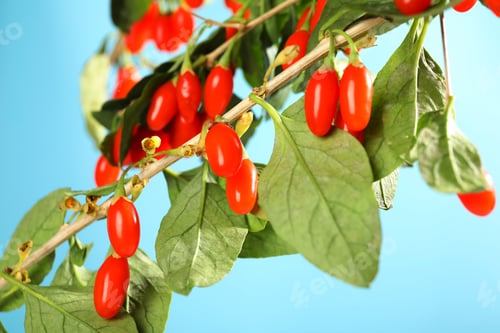
Picking Goji berries on bushes right next to a major local traffic route, I have noticed an abundance of berries from bushes right next to the road, in comparison to bushes set back from the same road on the same property under the care of the same gardener. Could increased carbon dioxide in the air have something to do with it?
Yes, but probably not mainly because of carbon dioxide. Roadside plants can sometimes benefit from warmer microclimates, extra nitrogen deposition, altered water availability, and reduced competition—while traffic pollution can also harm them. The unusually heavy fruiting is more likely a combination of these factors than a simple “more CO₂ makes more berries” effect.
Carbon dioxide: possible, but weak explanation
Vehicle exhaust can create short-lived CO₂ increases very close to a busy road, especially during calm conditions. Because goji is a C3 plant, elevated CO₂ can initially increase photosynthesis and biomass production. Controlled studies on goji found that CO₂ enrichment affected photosynthesis and fruit development, and could increase plant or fruit biomass under some conditions. However, the experimental enrichment was around 700 ppm for long periods, whereas outdoor roadside CO₂ increases are usually intermittent and rapidly dispersed. Long-term elevated CO₂ also caused reductions in goji fruit sugars and some secondary metabolites.[1][2][3]
So, CO₂ could contribute locally, but it would be difficult for ordinary traffic-related CO₂ alone to explain a dramatic difference in berry abundance.
More plausible roadside effects
Several other differences may be important:
- Nitrogen deposition: Vehicle exhaust contains nitrogen oxides, and roadsides can receive additional nitrogen through dry deposition. Nitrogen can stimulate leafy growth and, if the plant is not excessively stressed, potentially support more flowering and fruit production. Road-related effects on plant nitrogen and growth are commonly strongest within roughly 50–100 metres, though they can extend farther.[4][5]
- Heat and earlier development: Pavement and traffic create a warmer microclimate. In Edmonton, a roadside shrub may warm earlier in spring and remain warmer into autumn, potentially extending the growing season and improving fruit ripening.
- Light exposure: The roadside bushes may simply receive more direct sunlight or less shading from other plants, fences, buildings, or trees.
- Water conditions: Roadside grading, compacted soil, snowmelt, runoff, irrigation patterns, and reduced competition from surrounding vegetation can all alter water supply. Goji can fruit heavily when it receives adequate moisture without excessive shading.
- Pruning and browsing: Even subtle differences in pruning, winter damage, rabbit browsing, or shoot age can strongly affect goji fruiting. Goji often fruits on current-season growth, so a plant producing more vigorous new shoots may carry many more berries.
- Pollination and flowering conditions: Wind exposure, insect activity, and the timing of flowering may differ between the exposed roadside and the more sheltered part of the property.
Pollution may also be misleading
Traffic exposure is not uniformly beneficial. Ozone, nitrogen oxides, fine particles, road dust, salt, and hydrocarbons can damage leaves, alter stomatal function, reduce photosynthesis, or affect plant water relations. Roadside vegetation studies report both stimulated growth in some species and physiological damage in others.[5][6][4]
A roadside plant can therefore look vigorous and fruit heavily while still accumulating contaminants on its leaves and fruit. I would wash the berries thoroughly and avoid consuming berries from a location with visible dust, heavy winter-salt accumulation, or direct splash from the roadway. For berries intended for regular consumption, the set-back bushes are the safer choice unless the roadside plants have been tested.
How to test the explanation
You could distinguish CO₂ from the other factors with a simple comparison:
- Select several roadside and set-back bushes of similar age and size.
- Record direct sunlight, soil moisture, irrigation, pruning history, shoot length, flowers, and berries per metre of branch.
- Measure berry count and total berry mass separately; abundant small berries may indicate a different response than fewer large berries.
- Compare leaves for dust, salt injury, chlorosis, and pest damage.
- Take soil samples from both zones and compare nitrate, electrical conductivity, pH, organic matter, and available phosphorus.
- If possible, place a few comparable potted goji plants in roadside and set-back positions while giving them identical soil and water.
If the roadside potted plants also outperform the sheltered ones, the microclimate or air exposure is probably involved. If the effect disappears when soil, water, and sunlight are equalized, the cause is more likely soil fertility, drainage, heat, or competition than CO₂.
Bottom line: traffic-related CO₂ may play a minor supporting role, but increased nitrogen deposition, warmth, sunlight, water conditions, and reduced competition are more plausible explanations for the heavier goji crop.
⁂
- https://pmc.ncbi.nlm.nih.gov/articles/PMC7991576/
- https://academic.oup.com/treephys/article/39/6/1032/5368476?searchresult=1
- https://www.mdpi.com/2223-7747/10/2/321
- https://publications.naturalengland.org.uk/file/5064684469223424
- https://publications.naturalengland.org.uk/file/135001
- https://www.nature.com/articles/s41612-020-0115-3
- https://www.tandfonline.com/doi/full/10.1080/02757540.2020.1791102
- https://nora.nerc.ac.uk/id/eprint/5621/1/HonourN005621PP.pdf
- https://www.frontiersin.org/journals/plant-science/articles/10.3389/fpls.2022.802936/full
- https://pdfs.semanticscholar.org/a5c7/0a639e344e9ccf181bad68d7f7cc7858022d.pdf
- https://files.sdiarticle5.com/wp-content/uploads/2025/06/Revised-ms_AJEE_138150_v1.pdf
- https://www.witpress.com/Secure/elibrary/papers/UT03/UT03032FU.pdf
- https://pmc.ncbi.nlm.nih.gov/articles/PMC6060415/
- https://www.fs.usda.gov/psw/publications/mcpherson/psw_2013_mcpherson006_baldauf.pdf
- https://eprints.soton.ac.uk/382651/1/StreetscapingManuscript_EnvPolFullPaper_Submitted.pdf


No comments:
Post a Comment