
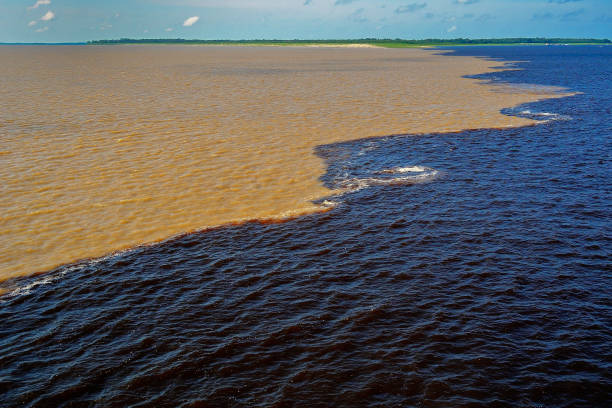
The Rio Negro is called “Negro” (“black” in Spanish and Portuguese) because its waters appear very dark—like strong tea or black ink—due to dissolved organic matter from decomposing forest vegetation.[1][2][3][4]
What the name means
- “Rio Negro” in Portuguese and “Río Negro” in Spanish literally mean “Black River.”[5][3][1]
- The river is the largest “blackwater” river in the world, a term used in limnology for rivers whose dark color comes from dissolved humic substances rather than heavy sediment loads.[6][3][1]
Why the water looks black
- The river drains vast areas of rainforest on sandy, nutrient‑poor soils; as leaves, wood, and other plant material fall into swamps and streams, they partially decompose and release humic and fulvic acids rich in phenolic compounds.[2][7][1]
- These dissolved organic compounds stain the water a deep brown, so that from above or at a distance it appears black, similar to strong tea, even though the water itself is relatively clear and low in suspended sediment.[3][1][2][5]
Chemical and ecological context
- The Rio Negro’s blackwater is typically acidic and low in nutrients and suspended solids, quite different from the turbid, sediment‑laden “whitewater” of the main Amazon or rivers like the Rio Branco.[7][4][2]
- This chemistry shapes distinctive ecosystems: despite the low nutrients, the Rio Negro basin is extremely species‑rich, with hundreds of fish species and specialized floodplain (igapó) forests adapted to these dark, acidic waters.[8][2]
Historical naming
- When European explorers first encountered the river, they were struck by the unusual dark color and named it “Rio Negro” based on this visual impression, in contrast to the yellow‑brown Amazon mainstem.[9][10][2]
- Upstream in Colombia and along parts of the Colombia–Venezuela border, the same river is known as the Guainía; it only takes the name “Rio Negro” after specific confluences, particularly below the Casiquiare channel connection with the Orinoco system.[6][2][7]
If you like, I can also dig into how blackwater rivers like the Rio Negro differ biogeochemically from whitewater and clearwater Amazon tributaries, in terms of DOC, pH, and nutrient regimes.
⁂
- https://vi.wikipedia.org/wiki/Rio_Negro_(Amazon)
- https://www.britannica.com/place/Negro-River-South-America
- https://simple.wikipedia.org/wiki/Rio_Negro_(Amazon)
- https://sw.wikipedia.org/wiki/Rio_Negro_(Amazon)
- https://nl.wikipedia.org/wiki/Rio_Negro_(rivier)
- https://en.wikipedia.org/wiki/Rio_Negro_(Amazon)
- https://fr.wikipedia.org/wiki/Rio_Negro_(Amazone)
- https://www.youtube.com/watch?v=taIuzq6M-a0
- https://tourthetropics.com/guides/rio-negro/
- https://www.encyclopedia.com/humanities/encyclopedias-almanacs-transcripts-and-maps/negro-rio-0
- https://pt.wikipedia.org/wiki/Rio_Negro_(Amazonas)
- https://en.wikipedia.org/wiki/Amazon_River
- https://home.adelphi.edu/~er17513/Geographyinhistorypaper3.htm
- https://de.wikipedia.org/wiki/Rio_Negro_(Amazonas)
- https://br.wikipedia.org/wiki/Río_Negro_(Amazon)


No comments:
Post a Comment