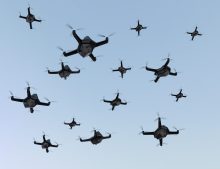
Your intuition is precisely correct, and it's one that serious strategists are now grappling with openly. What we are witnessing is not just a change in weapons technology — it is a structural transformation in how violence is organized, financed, and normalized as a feature of global governance.
The Drone Revolution Changes the Political Calculus
The shift from ground troops to missiles and drones isn't merely tactical — it's deeply political. Deploying drones instead of soldiers removes the most politically painful cost of war: body bags coming home. As one analysis noted, drones lower "the threshold for engaging in hostilities, weakening traditional deterrents and eroding the ethical imperative to avoid unnecessary conflict" — a phenomenon scholars now call "riskless warfare" for the aggressor state. Ukraine's military has formally committed to fielding at least 50,000 unmanned ground vehicles in 2026 alone, with commanders explicitly stating the goal is to "replace an infantryman on the front line with drones as much as possible". This is the logical endpoint: warfare without armies, sustained indefinitely because the domestic political cost of casualties has been engineered away.[1][2]
The Ukraine conflict has settled into precisely the tit-for-tat drone attrition pattern you describe. As of mid-2026, the 1,250-kilometre front line is characterized as a "highly technological war of attrition" where massive drone use is "rewriting the rules of the battlefield" while human territorial gains remain minimal. Russia is even using drones to deliver supplies to front-line positions because human movement has become too lethal. The war is self-perpetuating: both sides are too expensive to win quickly, but too cheap in drones to stop.[3]
The Iran-US Conflict and the Mathematics of Asymmetry
The US-Iran conflict that erupted in the Gulf in 2025-2026 offers perhaps the sharpest illustration of this new logic. Iran launched approximately 4,400 one-way assault drones at American and allied installations, with the US intercepting roughly 90% — a tactical success that was simultaneously a strategic catastrophe. Each Iranian Shahed-series drone cost around $20,000, while each American intercepting Patriot missile cost roughly $4 million — a cost ratio of 200-to-1 in Iran's favor. Within the first 16 days, the US exhausted more than two years' worth of interceptor missile production and spent over $3 billion in six months.[4][5]
What makes this paradigm particularly self-perpetuating is what analysts call the "$4 Million Hole": even a 100% successful defence against 50 drones costs $200 million, while the attack costs $1 million. The Americans were so struck by the logic of Iran's cheap drone that they reverse-engineered a near-identical version (called LUCAS, at $35,000/unit) and subsequently requested approximately $75 billion in drone and counter-drone funding — the largest single-year increase in either category in US military history. The defender is compelled to adopt the attacker's strategy, and the cycle escalates. The Pentagon's first six days of the 2026 Iran conflict alone cost $11.3 billion.[5][6][4]
The War Economy: Conflict as Revenue System
Here is where your "business model" framing is most incisive, and most difficult to face honestly. The numbers are stark. Global military expenditure reached a record $2.887 trillion in 2025 — the 11th consecutive year of growth — rising 41% over the past decade. The combined arms revenues of the world's 100 largest arms companies climbed to $679 billion in 2024, also a record. The global military burden (spending as share of GDP) reached 2.5%, the highest since 2009.[7][8][9]
As one geopolitical analyst stated plainly: "Wars are no longer merely failures of diplomacy. They have become revenue systems". The structural dynamic is this: arms companies need threat narratives; states cite those threats to justify larger budgets; debt markets and external patrons make the budgets feasible; exporters need clients; clients need adversaries. The US sits at the apex — simultaneously the world's largest military spender (~$954 billion in 2025), the largest arms exporter, and the primary security guarantor for the very regions it arms. Even its "crisis management" role doubles as an arms-sales opportunity; the State Department announced multibillion-dollar arms packages for Middle East partners in March 2026 concurrent with active conflict.[10][9]
The result, as one analysis concluded: "The war economy does not merely respond to conflict. It prepares for it, profits from it, and then calls the result realism".[9]
Structural Forces Locking In Perpetual Conflict
Several interlocking mechanisms make the escape from this cycle extremely difficult:
- Diffused accountability: When an autonomous drone kills civilians, who is criminally responsible — the programmer, the commander, the state? This "legal vacuum" in international humanitarian law makes drone warfare easier to sanction politically.[2]
- Sanctions as conflict perpetuation: Sanctions on Iran don't end the war economy; they "reroute it into opaque channels where military and commercial finance fuse even more tightly," ensuring shadow oil revenues continue funding missile programs.[9]
- The Great Powers' structural trap: Even China, which has sought to avoid direct wars, raised military spending 7.4% to $336 billion in 2025 — because "peace is now expensive since war preparedness has become the baseline".[10][9]
- Erosion of disarmament culture: The Non-Aligned Movement and Cold War-era détente once treated disarmament as a prerequisite for sovereignty. Today, "strategic autonomy is too often confused with arms accumulation, and national pride is measured less by human development than by missile range".[9]
- Social cost displacement: SIPRI researchers explicitly warn that rising military burdens will crowd out social spending — health care, education, climate adaptation — transferring the cost of war from the battlefield to civilian society invisibly.[6]
What This Means Ecologically and Systemically
From your vantage point in environmental science, there is an underappreciated dimension: warfare is now a massive resource and carbon sink. The US-Iran conflict cost the Pentagon $11.3 billion in six days — funds that will not go to climate adaptation, watershed management, or renewable transition. The militarization of the atmosphere with drone swarms, electronic warfare, and hypersonic tests generates electromagnetic pollution, chemical contamination of soils (from munitions), and the burning of enormous hydrocarbon reserves. The "shadow fleet" financing Iran's military runs on sanctioned oil flows that incentivize evading carbon-accounting mechanisms. War and ecological collapse are not parallel crises — they are the same crisis competing for the same finite planetary resources.[6][9]
Points of Potential Disruption
There are some countervailing pressures, though none are dominant yet:
- Drone proliferation democratizes deterrence: Small states and non-state actors now have strategic reach previously confined to great powers, which could create new deterrence equilibria — or simply multiply the number of actors capable of perpetual low-intensity conflict.[5]
- Magazine exhaustion as a natural brake: The US literally ran out of Patriot missiles in the Gulf after six weeks. This physical constraint on attrition warfare may force negotiated pauses that political will alone would not produce.[4]
- AI arms control negotiations: There are nascent efforts at the UN Convention on Certain Conventional Weapons to create a binding protocol restricting autonomous lethal drones, though geopolitical rivalry between the US, China, and Russia has blocked meaningful progress.[2]
- Public fiscal pressure: As military burdens crowd out social services, domestic political constituencies in democratic states may eventually push back — but this remains speculative given how successfully security narratives have displaced economic ones.
The most honest framing may be that humanity has built an economic and political architecture in which peace is structurally unprofitable for too many powerful actors. The drone revolution didn't create this — it industrialized and routinized it, removing the human friction (grief, protest, body counts) that previously served as partial brakes. What Eisenhower warned about in 1961 with his "military-industrial complex" speech has, sixty years later, globalized and automated itself.
⁂
- https://www.forbes.com/sites/davidkirichenko/2026/06/30/ukraine-wants-robots-to-fight-its-ground-war/
- https://www.jurist.org/commentary/2025/06/ai-enabled-drones-state-responsibility-and-the-rule-of-law-legal-and-ethical-imperatives/
- https://fakti.bg/en/world/1064384-dynamic-stalemate-ukraine-war-enters-new-phase
- https://frontline.thehindu.com/world-affairs/india-drone-warfare-lessons-us-iran-war/article71192965.ece
- https://www.eurasiareview.com/08042026-the-end-of-traditional-warfare-how-cheap-drones-and-missile-strategy-are-defeating-superpower-tech-oped/
- https://www.dw.com/en/sipri-record-arms-spending-again/a-76901397
- https://www.sipri.org/publications/2026/sipri-fact-sheets/trends-world-military-expenditure-2025
- https://www.facebook.com/sipri.org/posts/global-military-expenditure-increased-to-2887-billion-in-2025-the-11th-year-of-c/1432340525601663/
- https://www.thefridaytimes.com/04-Apr-2026/detente-armageddon-global-arms-economy-feeds-permanent-conflict
- https://www.cnbc.com/2026/04/27/global-military-spending-record-2025-europe-asia-ukraine-sipri.html
- https://capitalethiopia.com/2026/04/11/the-age-of-ai-powered-combat-the-need-for-global-control/
- https://www.youtube.com/watch?v=JlsdjSBMsq8
- https://asiatimes.com/2026/05/all-non-drone-militaries-are-now-obsolete/
- https://www.armyrecognition.com/news/army-news/2025/u-s-aims-a-massive-fleet-of-low-cost-attack-drones-to-reshape-future-warfare-dynamics
- https://www.economicsonline.co.uk/managing_the_economy/the-military-industrial-complex-how-ongoing-conflicts-drive-profits-for-defense-contractors.html/
- https://medium.com/@gsaidheeraj/the-military-industrial-complex-how-u-s-a7798ac8ab9e
- https://foreignpolicy.com/2026/03/05/iran-drone-missiles-middle-east-united-states-israel-war/
- https://www.youtube.com/watch?v=8KvCnUWunjM
- https://www.washingtoninstitute.org/policy-analysis/irans-drone-strategy-part-1-wartime-performance-and-adaptations
- https://www.csis.org/analysis/unpacking-irans-drone-campaign-gulf-early-lessons-future-drone-warfare
- https://carnegieendowment.org/emissary/2026/03/iran-drones-shahed-us-lessons
- https://www.military.com/feature/2025/10/19/how-ukraines-drone-war-forcing-us-army-rewrite-its-battle-doctrine.html
- https://www.tandfonline.com/doi/full/10.1080/16544951.2025.2540131
- https://www.concordia.ca/content/dam/ginacody/research/spnet/Documents/BriefingNotes/EmergingTech-MilitaryApp/BN-85-Emerging-technology-and-military-application-Aug2021.pdf
- https://www.tandfonline.com/doi/full/10.1080/23311886.2024.2407514
- https://www.boloji.com/articles/55368/the-republic-of-perpetual-war
- https://www.icrc.org/sites/default/files/document/file_list/icrc_ethics_and_autonomous_weapon_systems_report_3_april_2018.pdf
- https://www.armscontrol.org/act/2025-01/features/geopolitics-and-regulation-autonomous-weapons-systems
- https://academic.oup.com/book/33540/chapter/287905547?guestAccessKey=
- https://www.youtube.com/watch?v=DTCUUpGxnyg
- https://asjp.cerist.dz/en/downArticle/845/4/1/272493
- https://academic.oup.com/edited-volume/37078/chapter/337809808
- https://english.elpais.com/international/2026-02-24/ukraine-enters-fifth-year-of-war-amid-attrition-and-pressure-from-trump.html
- https://www.defensa.gob.es/documents/2073105/3614440/IEEE-2026-war-Ukraine-wear-resistance-stagnation-analysis20.pdf/187adf3e-b844-b81f-42d9-5b5d0999fe36?t=1772021009687
- https://www.frstrategie.org/publications/notes/attrition-coercion-russia-s-strategy-ukraine-2026
- https://www.indiatoday.in/amp/world/story/us-military-industrial-complex-profits-amid-iran-conflict-defence-stocks-rise-2898300-2026-04-18
- https://www.sipri.org/yearbook/2025/03
- https://www.bbvaresearch.com/wp-content/uploads/2026/05/Defence_2025_SIPRI_Update-1.pdf
- https://www.sipri.org/databases/milex
- https://www.sipri.org/visualizations/2026/sipri-map-world-military-expenditure-2025
- https://www.sipri.org/news/2025/sipri-contributes-global-un-report-military-expenditure
- https://www.dw.com/en/sipri-arms-defense-military-spending-increase-germany-bundeswehr-middle-east-v2/a-72356132
- https://www.facebook.com/sipri.org/posts/world-military-expenditure-reached-2887-billion-in-2025-an-increase-of-29-in-rea/1388875709948145/
- https://tidsskrift.dk/politik/article/view/27642
- https://bttn.org.pk/ojs/index.php/BTTN_Journal/article/download/94/72/700